
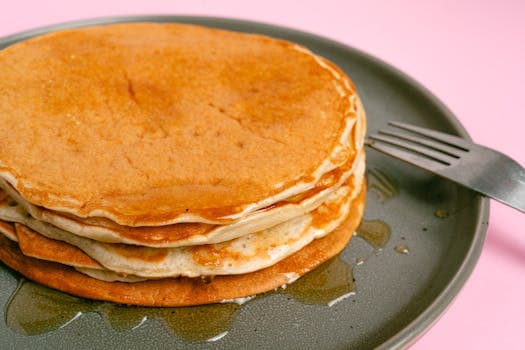
Classic American Buttermilk Pancakes
Fluffy buttermilk pancakes with golden edges — pure American breakfast comfort.
About This Recipe
The American buttermilk pancake is a study in how chemistry and restraint produce something seemingly magical. Buttermilk — acidic and slightly thick — reacts with both the baking soda and baking powder in the batter to produce carbon dioxide, which inflates the gluten structure as the batter hits a hot griddle. The result, when everything is handled correctly, is a pancake that rises a full half-inch on each side with a cloud-soft interior and a golden, slightly crisp exterior. The secret that most recipes undersell is how little stirring is required: the moment the wet and dry ingredients begin combining, gluten starts forming and the leavening gases begin escaping. Fifteen to twenty stirs is enough — the batter should look rough and lumpy, not smooth like cake batter. Smooth pancake batter almost always means overworked gluten and flat, tough pancakes. Buttermilk does three things simultaneously: its acid activates the baking soda for lift, its slight thickness slows the spread of batter on the griddle so pancakes stay tall rather than thin, and its tangy flavor balances the sugar and butter in the finished stack. A 5-minute rest after mixing allows the leavening reaction to stabilize and gives the flour time to fully hydrate, producing a slightly thicker batter that holds its shape better on the griddle. The heat level matters too — medium to medium-low keeps the interior fully set before the exterior browns, whereas a too-hot griddle burns the bottom before the pancake is cooked through. The right moment to flip is when bubbles have formed across the entire surface and the edges look matte rather than wet and shiny. Cook the second side half as long: 60 to 90 seconds is typically enough.
Ingredients
Serves 4
- 2 cupsall-purpose flour
- 2 tbspgranulated sugar
- 1 tspbaking soda
- 1 tspbaking powder
- ½ tspfine salt
- 2 cupsbuttermilk(well-shaken, full-fat)
- 2large eggs
- 2 tbspunsalted butter(melted and cooled slightly)
- 1 tsppure vanilla extract
- butter or neutral oilfor the griddle
Instructions
- 1
Whisk the dry ingredients
In a large bowl, whisk together the flour, sugar, baking soda, baking powder, and salt until evenly combined. Making the dry mix thorough now means you won't have to overmix once the wet ingredients are added.
Use a wide bowl that gives you plenty of room to fold in the wet ingredients without the batter spilling over the sides.
- 2
Whisk the wet ingredients
In a separate medium bowl, whisk the buttermilk, eggs, melted butter, and vanilla together until the eggs are fully incorporated. Make sure the butter isn't still hot from the microwave — if it is, it will begin cooking the eggs on contact. Room-temperature or barely warm butter is ideal.
- 3
Combine with minimal stirring
Pour the wet ingredients into the dry ingredients all at once. Using a wide spatula or wooden spoon, fold the two together with large strokes — stop the moment no dry flour streaks remain. The batter will look rough and lumpy, almost distressingly so, and that is exactly correct. Count your strokes: 15–20 is the goal, 25 is the absolute maximum.
Every extra stir develops gluten and lets more leavening gas escape — overworked batter produces flat, rubbery pancakes no matter how good your other technique is.
- 4
Rest the batter
Set the bowl aside and let the batter rest uncovered for 5 minutes. During this time the leavening reaction stabilizes, the flour fully hydrates, and the batter thickens slightly — which helps the pancakes hold their shape and height on the griddle rather than spreading into thin discs.
- 5
Heat and grease the griddle
Set a large griddle or non-stick skillet over medium heat. After 2 minutes, add a small pat of butter and let it melt and stop foaming — if it immediately turns brown, the pan is too hot. Adjust to medium-low. Swirl the butter to coat, then wipe out any excess with a paper towel (excess butter causes uneven browning).
Consistent medium heat is the key — a griddle that's too cool makes pale, dense pancakes; too hot burns the exterior before the interior sets.
- 6
Cook the first side
Pour approximately ¼ cup of batter per pancake onto the griddle, leaving a few inches between each one. The batter will spread slightly into a round. Cook undisturbed for 2–3 minutes: you're looking for bubbles to form across the entire surface and the edges to turn from shiny and wet to matte and set. These are the signals that the interior is cooked enough to survive flipping.
- 7
Flip and finish
Slide a wide spatula completely under each pancake and flip in a single confident motion — hesitation leads to folding instead of flipping. Cook the second side for 60–90 seconds until it's golden brown. Transfer to a wire rack or baking sheet in a 200°F oven to keep warm while you cook the remaining batches.
- 8
Serve immediately
Stack 3–4 pancakes per plate and add a generous pat of cold butter to the top so it melts slowly down through the stack as you eat. Serve with pure maple syrup warmed briefly in a small saucepan or microwave — warm syrup spreads into the pancakes rather than pooling on top.
Did you make this?
Rate it and help other cooks find the recipes that actually work.
One tap to sign in, and we'll save the rating you just picked.
Everything you need to plan your week — free
- Meal calendar
- Grocery list
- AI recipe ideas
Track what you eat
Snap your meal to log calories and macros, run fasting timers and track water in the free SnapCal app.
Pro Tips
- →
Stop mixing the moment the dry flour streaks disappear — lumpy batter makes fluffy pancakes; smooth batter makes tough, flat ones because overmixing develops gluten and releases the leavening gas before the batter hits the griddle.
- →
Let the batter rest 5 minutes before cooking so the flour hydrates fully and the leavening stabilizes — rested batter produces pancakes that are noticeably taller.
- →
Use medium to medium-low heat throughout; a too-hot griddle browns the bottom before the interior sets, leaving you with pancakes that look golden but taste gummy inside.
- →
The right flip signal is two things together: bubbles across the entire surface AND matte, set edges — waiting for both ensures the pancake is structurally ready to be inverted without tearing.
- →
Keep finished pancakes warm on a wire rack set in a 200°F oven rather than stacking them directly — stacking traps steam underneath and makes the bottoms soggy.
Variations
- •
Blueberry buttermilk pancakes: fold 1 cup of fresh or frozen blueberries into the batter just before cooking — frozen work best added straight from the freezer so they don't stain the batter purple.
- •
Chocolate chip pancakes: fold in ½ cup of mini chocolate chips after resting the batter; mini chips distribute more evenly than regular-size ones.
- •
Whole wheat pancakes: substitute 1 cup of the all-purpose flour with whole wheat flour for a nuttier flavor and denser texture — add 2 tablespoons of extra buttermilk to compensate for the added absorbency.
- •
Sourdough pancakes: replace the buttermilk with 1½ cups of active sourdough discard, reduce the baking soda to ½ tsp, and add 2 tablespoons of milk to adjust thickness — the result has wonderful tang and complexity.
Storage
Cooked pancakes keep refrigerated in an airtight container for up to 3 days. For longer storage, freeze individual pancakes in a single layer on a sheet pan until solid, then transfer to a freezer bag — they keep frozen for up to 2 months. Reheat refrigerated pancakes in a toaster or in a 350°F oven for 4–5 minutes; frozen pancakes can go straight from the freezer into a toaster on medium setting.
History & Origin
Flat griddle cakes made from ground grain and liquid appear in nearly every culinary tradition across history, but the distinctly American buttermilk pancake took its modern form after the widespread commercialization of baking powder in the 1850s and 1860s. Before chemical leavening, American pancakes were dense and flat; the introduction of baking powder and baking soda transformed them into the tall, fluffy stacks that became central to American breakfast culture. Buttermilk, a byproduct of butter churning that was widely available on American farms, became the preferred liquid because it produced superior rise and better flavor than plain milk — and by the late 19th century, the combination of buttermilk, baking powder, and baking soda had become the standard American pancake formula.
Frequently Asked Questions
Can I make these without buttermilk?
Yes — the best substitute is a quick acidified milk: add 1 tablespoon of white vinegar or fresh lemon juice to a measuring cup, then fill to the 1-cup line with whole milk, stir, and let sit for 5 minutes until the milk curdles slightly. Use in the same quantity as buttermilk. Plain whole-milk yogurt thinned with a little milk to pourable consistency is another excellent substitute that produces slightly thicker, richer pancakes. The key is the acid — it reacts with the baking soda to produce lift.
Why are my pancakes dense and rubbery?
Overmixing is the single most common cause — even 10 extra stirs beyond what's needed develops enough gluten to ruin the texture. Stop the moment no dry streaks remain and accept that the batter looks lumpy. A second cause is skipping the rest period: un-rested batter spreads too thin on the griddle. A third cause is too-high heat, which sets the exterior crust before the interior has risen fully.
Can I make the batter the night before?
The dry and wet ingredients can be prepped separately and stored overnight — combine the dry mix in one bowl, whisk the wet ingredients in a sealed jar in the refrigerator. In the morning, combine them and let the batter rest 5 minutes before cooking. However, fully mixed batter should not sit overnight: the baking soda and baking powder begin reacting on contact with the buttermilk, and by morning most of the leavening power is spent, leaving you with flat, dense pancakes.
Why do my pancakes burn on the outside but stay raw inside?
The griddle is too hot — this is almost always the cause. Many home cooks overheat their pans trying to compensate for a slow preheat. Set the burner to medium, allow 2 full minutes of preheating, then test by dropping a few drops of water on the surface: they should skitter and evaporate in a few seconds (not instantly, which would mean too hot). Reduce heat if the butter browns immediately upon contact.
Nutrition Facts
Per serving (300g / 10.6 oz) · 4 servings total
Time Summary
Have Questions?
Ask our AI cooking assistant anything about this recipe — substitutions, techniques, scaling.
Chat with AI Chef →Featured in Guides
This recipe is featured in the following curated guides:
More American Recipes
You Might Also Like
Similar dishes from other cuisines around the world.
Browse by Ingredient
More recipes built around the same core ingredients.
Free Kitchen Tools
Calculators and converters that pair with this page — no signup needed.
Put This Into a Plan
Schedule it, shop for it, and track what you already have.
Read Next
Longer reads that go deeper on the ideas behind this dish.
Community
Join the conversation
Sign in to leave a comment and save your favourite recipes