
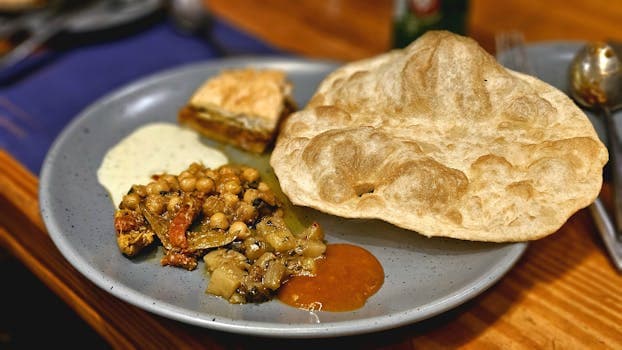
Dholl Puri
Mauritius's beloved street flatbread stuffed with spiced yellow split peas.
About This Recipe
Dholl Puri is the unofficial national street food of Mauritius — a thin, supple flatbread that has become a symbol of the island's extraordinary culinary fusion. The bread itself is made from a soft, oiled dough rolled as thin as a crepe, then filled with a fragrant paste of ground yellow split peas (dholl) seasoned with cumin, turmeric, and a touch of salt before being sealed and rolled out again. The result is a delicate, slightly layered disc that puffs lightly on a hot tawa and develops pale golden spots on its surface. What separates dholl puri from a plain roti is that the filling is built into the dough itself — the peas become an invisible, creamy layer that keeps the flatbread soft and moist even hours later. On the streets of Port Louis, Mahebourg, and Grand Baie, dholl puri vendors set up their tawas at dawn and serve hundreds of puris a day, rolling, filling, and cooking in a seamless rhythm. A complete street serving comes wrapped in newspaper or a banana leaf and includes rougaille (Creole tomato sauce), achard (pickled vegetables), white beans in sauce, and coconut chutney — each component adding sweet, sour, or spicy contrast to the mild, earthy flatbread. This layering of flavours from different cultural traditions — Indian, Creole, Chinese, and French — is what makes dholl puri a true expression of Mauritian identity. Mastering the rolling technique, which requires evenly distributing the pea filling and achieving a nearly translucent thinness, is the real skill, and every experienced cook takes pride in the delicacy of their puri.
Ingredients
Serves 6
- 2 cupsall-purpose flour
- 1 cupyellow split peas, cooked and drained
- 1 tspground cumin
- 1/2 tspturmeric
- 1/2 tspsalt
- 2 tbspoil
Instructions
- 1
Season the peas
Blend cooked split peas with cumin, turmeric, and a pinch of salt in a food processor or mortar, pulsing to a rough, dry paste — not smooth hummus. The mixture should hold its shape when squeezed but crumble apart easily.
If the pea paste is too wet, spread it on a plate and let it air-dry for 10 minutes; moisture in the filling tears the dough during rolling.
- 2
Make the dough
Combine flour, salt, and oil in a bowl; add warm water gradually (roughly 3/4 cup), kneading for 5–6 minutes until the dough is smooth, soft, and slightly tacky — softer than bread dough but not sticky. Cover with a damp cloth and rest 20 minutes so the gluten relaxes.
Warm water (not hot) keeps the dough pliable; cold water makes it elastic and hard to roll thin.
- 3
Portion and fill
Divide dough into 12 equal balls (roughly 50g each). Flatten one ball into a 10cm disc on a lightly floured surface, place a generous tablespoon of pea paste in the centre, gather the dough edges up around the filling, and pinch firmly to seal with no air pockets.
- 4
Roll out thin
Gently roll the filled ball out to a thin disc, about 20–22cm across (roughly the size of a dinner plate), turning it a quarter-turn between each pass of the rolling pin. The pea paste will spread through the dough; this is correct and gives dholl puri its characteristic soft interior.
Use a very light touch at the edges — pressing too hard will tear the skin and expose the filling.
- 5
Cook on the tawa
Place on a dry, very hot tawa or cast-iron skillet over medium-high heat. Cook 60–90 seconds on the first side until light brown spots appear and the surface starts to look dry, then flip and cook 60 seconds more. The puri should stay soft and pliable, not crisp.
- 6
Keep warm and serve
Stack cooked puris on a plate covered with a clean tea towel, which traps steam and keeps them soft. Serve warm with rougaille, white beans, achard pickles, and coconut chutney on the side for wrapping.
Did you make this?
Rate it and help other cooks find the recipes that actually work.
One tap to sign in, and we'll save the rating you just picked.
Everything you need to plan your week — free
- Meal calendar
- Grocery list
- AI recipe ideas
Track what you eat
Snap your meal to log calories and macros, run fasting timers and track water in the free SnapCal app.
Pro Tips
- →
Keep the rolling surface just barely dusted with flour — too much flour on the outside causes the puri to slide on the tawa and cook unevenly.
- →
Drain and dry the split peas thoroughly after cooking; excess moisture causes steam pockets in the filling that split the dough.
- →
Roll the filled dough balls slowly and gently, pivoting after each roll — rushing tears the thin skin over the pea paste.
- →
A heavy cast-iron tawa retains heat best; if your pan is too light, the temperature drops when the puri touches it and the bread absorbs grease instead of toasting.
- →
For service, fold each warm puri in half twice (into quarters) and wrap in a piece of banana leaf or parchment — the street vendor way — which makes eating while standing much easier.
Variations
- •
Spiced pea filling: add a finely chopped green chilli and a pinch of garam masala to the split pea paste for a more complex, aromatic filling.
- •
Whole-wheat version: substitute half the all-purpose flour with whole-wheat flour for a nuttier flavour and slightly denser texture.
- •
Cassava dholl puri: replace 1/4 of the flour with finely grated, dried cassava for a traditional variation found in rural parts of Mauritius.
- •
Mini street-snack version: make golf-ball-sized dough balls for bite-sized puris ideal for parties and appetiser platters.
Storage
Wrap cooked puris in a clean cotton cloth and store at room temperature up to 4 hours — they stay soft inside the cloth as residual steam is retained. For longer storage, refrigerate in a zip-lock bag up to 2 days and reheat on a dry pan for 30 seconds per side. Do not microwave, which makes them rubbery.
History & Origin
Dholl puri arrived in Mauritius with Indian indentured labourers recruited between 1834 and 1923 to work British sugar-cane plantations after the abolition of slavery. These labourers, predominantly from Bihar and Uttar Pradesh, brought with them the tradition of stuffed flatbreads, which gradually merged with local Creole ingredients and street-food culture. By the mid-20th century, dholl puri had transcended its Indian origins and become the shared street food of all Mauritian communities — Hindu, Muslim, Creole, and Chinese alike. Today it is listed among the island's most defining cultural exports and debated with affectionate passion on questions of proper filling texture and tawa temperature.
Frequently Asked Questions
Can I freeze the dough?
Yes — wrap individual filled dough balls (before rolling) tightly in cling film and freeze for up to one month. Thaw overnight in the fridge, then bring to room temperature for 30 minutes before rolling and cooking. The texture is indistinguishable from fresh.
What do I serve with Dholl Puri?
The classic accompaniments are rougaille (Creole tomato sauce with sausage or fish), white kidney beans braised in a light tomato sauce, achard pickles (julienned vegetables pickled with turmeric and mustard seeds), and a fresh coconut chutney. Together they cover sweet, sour, spicy, and savoury — the full range of Mauritian flavour.
Why does my dholl puri tear when I roll it?
The two most common causes are filling that is too wet (drain and dry the peas thoroughly) and dough that hasn't rested long enough (the gluten needs 20 minutes to relax). Also, roll gently and evenly from the centre outward rather than pressing hard from the edge.
Can I make the filling the day before?
Absolutely. Cook and season the split peas, let them cool completely, then refrigerate overnight in an airtight container. Cold filling is actually easier to work with because it holds its shape when you seal the dough balls.
Is dholl puri gluten-free?
No — it uses standard wheat flour. For a gluten-free version, you can experiment with a blend of rice flour and tapioca starch, though the texture will be less pliable and more prone to cracking at the edges.
Nutrition Facts
Per serving (150g / 5.3 oz) · 6 servings total
Time Summary
Have Questions?
Ask our AI cooking assistant anything about this recipe — substitutions, techniques, scaling.
Chat with AI Chef →Featured in Guides
This recipe is featured in the following curated guides:
More Mauritian Recipes
You Might Also Like
Similar dishes from other cuisines around the world.
Free Kitchen Tools
Calculators and converters that pair with this page — no signup needed.
Put This Into a Plan
Schedule it, shop for it, and track what you already have.
Read Next
Longer reads that go deeper on the ideas behind this dish.
Community
Join the conversation
Sign in to leave a comment and save your favourite recipes