
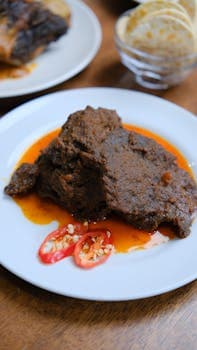
Padang Beef Rendang — Wongso-Inspired
Slow-cooked beef in a deeply spiced coconut paste — caramelised over hours until almost dry — Indonesia's most celebrated dish.
⭐Inspired by William Wongso · 🇮🇩 IndonesiaAbout This Recipe
This dish is inspired by Chef William Wongso's lifelong championship of Padang rendang — the West Sumatran masterpiece that topped CNN's 2011 World's 50 Most Delicious Foods list, a poll Wongso himself helped publicise. Wongso has insisted, correctly, that proper rendang is not a curry but a slow caramelisation: beef and coconut milk are cooked together for 3–4 hours until the liquid evaporates entirely, leaving the beef coated in a dark, deeply flavoured spice paste. This is our take on the Minangkabau (West Sumatran) tradition Wongso has globalised.
Ingredients
Serves 6
- 1.5 kgbeef chuck or shin(cut into 4cm cubes)
- 1.5 Lcoconut milk(full-fat, freshly extracted ideally)
- 12shallots(or 3 medium red onions)
- 8 clovesgarlic
- 5 cmfresh ginger(peeled)
- 5 cmfresh galangal(peeled)
- 4 cmfresh turmeric(peeled, or 1 tsp ground turmeric)
- 10dried red chilies(soaked in hot water 20 mins, drained)
- 5fresh red chilies(stems removed)
- 2 stalkslemongrass(white parts only, bruised)
- 5kaffir lime leaves
- 2salam leaves(or bay leaves)
- 1 stickcinnamon
- 3whole star anise
- 5whole cloves
- 3green cardamom pods
- 1 tbsptamarind paste
- 60 gtoasted desiccated coconut(ground to powder (kerisik))
- 1 tbspsalt(or to taste)
- 1 tsppalm sugar(or brown sugar)
Instructions
- 1
Make the spice paste (bumbu)
Blend the shallots, garlic, ginger, galangal, turmeric, soaked dried chilies and fresh chilies into a thick, smooth paste. Add a splash of water if needed. This is your rendang bumbu — the foundation of the entire dish.
A traditional cobek (Indonesian stone mortar) gives the best texture, but a high-powered blender is fine.
- 2
Build the cooking liquid
In a large heavy-bottomed pot, combine the coconut milk, spice paste, lemongrass, kaffir lime leaves, salam leaves, cinnamon, star anise, cloves, cardamom and tamarind. Bring to a gentle simmer over medium heat, stirring constantly to prevent the coconut milk splitting.
- 3
Add beef and reduce — phase 1 (KALIO)
Add the beef and salt. Simmer uncovered, stirring every 10–15 minutes, for about 90 minutes. The liquid will reduce by half and the colour will deepen to golden-brown. This stage is called KALIO — it is rendang's first phase but not the final form.
Stir often — the coconut milk will catch and burn if neglected.
- 4
Phase 2 — KERING
Continue simmering uncovered for another 60–90 minutes. The liquid will reduce further and the spice paste will start coating the beef. Stir more frequently now — every 5–7 minutes — to prevent sticking. The colour deepens to dark brown.
- 5
Phase 3 — RENDANG (the finished form)
Continue cooking for the final 30–60 minutes, stirring constantly. The liquid should evaporate completely; the beef should be coated in a dark, almost dry spice crust; the colour should be a deep mahogany-black. Stir in the kerisik (toasted ground coconut) and palm sugar in the last 5 minutes. Taste and adjust salt.
- 6
Serve
Serve hot or at room temperature with steamed jasmine rice. Traditional Padang accompaniments include green chili sambal, sayur nangka (jackfruit curry) and crisp prawn crackers. Rendang tastes EVEN better the next day after the spices marry overnight.
Did you make this?
Rate it and help other cooks find the recipes that actually work.
One tap to sign in, and we'll save the rating you just picked.
Everything you need to plan your week — free
- Meal calendar
- Grocery list
- AI recipe ideas
Cook this hands-free
Get AI meal plans, step-by-step cooking mode, and your saved recipes in the free Bento app.
Pro Tips
- →
Rendang must reach all three phases — kalio, kering, rendang — to be authentic. Stop too early and you have a curry, not a rendang.
- →
Use cuts with collagen (chuck, shin) — not lean cuts. The 4-hour cook breaks down the connective tissue beautifully.
- →
Kerisik (toasted ground coconut) is non-negotiable — it adds the characteristic deep nuttiness.
Variations
- •
Rendang Ayam: substitute chicken thighs for beef — reduces cooking time to about 90 minutes total.
- •
Padang Vegetable Variation: substitute jackfruit (young, unripe) for beef for a Minangkabau vegetarian dish.
- •
Stop at Kalio: the first phase (90 mins) gives a richer, saucier dish that's also delicious — common in Java but not 'true' rendang.
Storage
Improves with age — keep refrigerated for up to 1 week. Freezes for up to 3 months. Some Padang households age rendang for several days before serving.
History & Origin
Rendang originated with the Minangkabau people of West Sumatra. Traditionally cooked at major life events (weddings, religious feasts), the long cooking time and spice mixture were partly designed to preserve meat in the tropics before refrigeration. In 2011 it topped CNN's poll of the World's 50 Most Delicious Foods — a result William Wongso publicly championed.
Frequently Asked Questions
Why does rendang take 4 hours?
Rendang is not a curry that's done when the meat is cooked — it's a slow caramelisation. Over 3–4 hours the coconut milk reduces, the spices deepen, and the beef ends up coated in a dark, almost dry paste. Stop too early and you have kalio (a stew); cook to the end and you have true rendang.
What is kerisik?
Kerisik is freshly grated coconut, dry-toasted in a pan until deep golden-brown, then ground to a slightly oily paste. It is essential to authentic rendang — added at the end to deepen the nuttiness and the dark colour. It cannot be substituted with regular desiccated coconut.
Why did rendang top CNN's '50 Most Delicious Foods'?
In CNN's 2011 reader poll, rendang topped the list above sushi, pho and pizza. William Wongso publicly championed the result and used it as a platform to argue for global recognition of Padang cuisine. The poll has since been widely cited in Indonesian culinary diplomacy.
What is the difference between kalio and rendang?
Kalio is the first phase of cooking (90-120 minutes) where the dish is still saucy and reddish-brown. True rendang is the final phase — the liquid has fully evaporated and the meat is coated in a dark, almost dry spice paste. Many non-Indonesian restaurants serve kalio mislabelled as rendang.
How long does rendang really keep?
Properly made rendang — fully dried in the rendang phase — keeps for 1-2 weeks at room temperature in the tropics, weeks longer refrigerated, and freezes indefinitely. Traditional Padang households would prepare rendang at major life events to feed dozens for days.
Nutrition Facts
Per serving (320g / 11.3 oz) · 6 servings total
Time Summary
Have Questions?
Ask our AI cooking assistant anything about this recipe — substitutions, techniques, scaling.
Chat with AI Chef →Featured in Guides
This recipe is featured in the following curated guides:
More Indonesian Recipes
You Might Also Like
Similar dishes from other cuisines around the world.
Browse by Ingredient
More recipes built around the same core ingredients.
Free Kitchen Tools
Calculators and converters that pair with this page — no signup needed.
Put This Into a Plan
Schedule it, shop for it, and track what you already have.
Read Next
Longer reads that go deeper on the ideas behind this dish.
Community
Join the conversation
Sign in to leave a comment and save your favourite recipes