
portuguesedessert✨ New
Pastéis de Nata (Portuguese Egg Tarts)
Flaky custard tarts with caramelised tops from Lisbon.
Prep
30 min
Cook
20 min
Servings
12
Difficulty
Hard
4.9
Sign in to rate#dessert#pastry#custard#portuguese
Flaky custard tarts with caramelised tops from Lisbon.
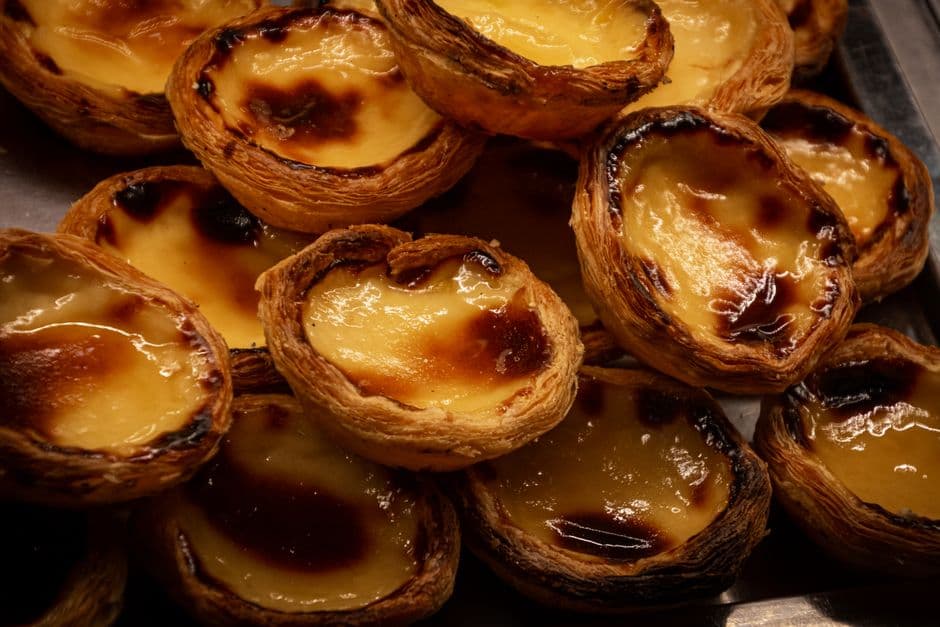
Born in the Jerónimos Monastery in Belém, pastéis de nata are Portugal's most famous pastry — crispy, flaky puff pastry shells filled with a rich, slightly runny egg custard that blisters and caramelises in a very hot oven, producing a burnished, wobbly filling with charred pockets.
Serves 12
Combine sugar, water, cinnamon stick, and lemon peel in a small saucepan. Bring to a boil without stirring and cook for 3 minutes until slightly thickened (113°C on a thermometer). Remove cinnamon and lemon peel.
Whisk flour with 50ml of the milk until smooth. Heat remaining milk and cream in a saucepan until just simmering. Whisk in flour mixture and cook 2 minutes until thickened slightly. Remove from heat.
Slowly whisk the hot sugar syrup into the warm milk mixture. Whisk in egg yolks and vanilla. Strain through a fine sieve. Cool slightly.
Preheat oven to 250°C (480°F) — as high as your oven goes. Cut puff pastry into 12 rounds slightly larger than a standard muffin tin cup. Press each into the cups, pressing up the sides.
Fill each pastry case three-quarters full with custard. Bake on the top shelf for 15–18 minutes until the custard is set with dark burnished spots and the pastry is deep golden.
Cool for 5 minutes. Dust with cinnamon and icing sugar. Eat warm — these are at their best within an hour of baking.
Everything you need to plan your week — free
Cook this hands-free
Get AI meal plans, step-by-step cooking mode, and your saved recipes in the free Bento app.
The highest oven temperature is essential for the characteristic charred custard top.
The custard should still have a slight wobble when it comes out — it firms as it cools.
Weigh dry ingredients on a scale instead of using cups — grams are the difference between a tender and a tough crumb.
Bring eggs and dairy to room temperature before mixing; cold ingredients seize fats and produce a dense, uneven texture.
Add a teaspoon of orange zest to the custard for a citrus version.
Use shortcrust pastry for a denser, less flaky shell.
Vegetarian: swap the protein for roasted king oyster mushrooms, smoked tofu or cooked chickpeas — adjust seasoning slightly upward to compensate.
Spicier: add a finely chopped fresh chile or a teaspoon of crushed Aleppo/Urfa pepper to the aromatics for warm, layered heat instead of a single sharp hit.
Best eaten on the day of baking. Store at room temperature up to 1 day. Do not refrigerate as the pastry softens.
Pastéis de Nata (Portuguese Egg Tarts) is shaped by the home cooks who refined it across generations, balancing tradition with everyday practicality. Regional variations are the rule rather than the exception — neighboring villages, families and even individual cooks adapt the dish to what's in the pantry and what's in season, which is why no two versions taste exactly alike and why the recipe has stayed alive for so long.
Yes — most of the components can be prepared up to a day in advance and refrigerated separately. Reheat gently and assemble just before serving so textures stay distinct.
Stay close to the role each ingredient plays: swap aromatics for similar ones (shallot for onion, lime for lemon), and keep the fat-acid-salt balance intact. Spice blends can usually be approximated with what's in the cupboard.
Authenticity sits on a spectrum — what matters more is honoring the technique and balance of flavors. If the dish tastes harmonious and respects how cooks in its home region would build it, you're on solid ground.
The two most common issues are under-seasoning and rushing the heat. Taste as you go, season in layers, and give aromatics and proteins the time they need to develop color and depth before moving on.
Per serving (80g / 2.8 oz) · 12 servings total
Ask our AI cooking assistant anything about this recipe — substitutions, techniques, scaling.
Chat with AI Chef →This recipe is featured in the following curated guides:
Join the conversation
Sign in to leave a comment and save your favourite recipes
Everything you need to plan your week — free
Have feedback or need help?
We read every email and reply within 1–2 business days.
© 2026 MyCookingCalendar. All rights reserved.