
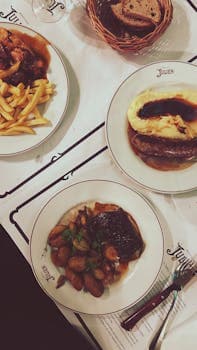
Cassoulet
Französischer langsam gekochter weiße-bohnen-eintopf mit enten-confit, wurst und schweinefleisch — seelen-wärmend languedoc-klassiker.
Über dieses Rezept
Cassoulet ist der könig französischer bauerngericht — weiße bohnen langsam köcheln mit enten-confit, knoblauch-wurst und schweineschulter, fertiggestellt mit goldener bröselbrot-kruste. Es ist eine lange, liebevolle arbeit, die geduld mit tief geschichteten, seelen-wärmend geschmack belohnt. Jede region südwest-frankreichs (castelnaudary, carcassonne, toulouse) beansprucht ihre eigene version. Die kruste muss siebenmal gebrochen und reformiert werden — sagt die legende.
Zutaten
Dient 8
- 500 ggetrocknete weiße bohnen (tarbais oder great northern), über nacht eingeweicht
- 4 legsenten-confit
- 400 gtoulouse wurst (oder knoblauch-schweinewurst)
- 400 gschweineschulter, gewürfelt
- 200 gdicker speck, gehackt
- 2 großezwiebeln, gehackt
- 1 Kopfknoblauch, zehen separat geschält
- 2möhren, gehackt
- 2 ELtomatenmark
- 2 Tassenhühnerbrühe
- 2 Tassentrockener weißwein
- 3 Zweigefrischer thymian
- 2lorbeerblätter
- 1 Tassefrisches bröselbrot
- 3 ELenten-fett oder olivenöl
- salz und pfeffer
Anleitung
- 1
Bohnen kochen
Eingeweichte bohnen ablaufen. Mit frischem wasser im topf bedecken. Zum kochen bringen, 1 stunde köcheln, bis gerade eben zart. Kochflüssigkeit reservieren.
- 2
Wurst und schwein anbraten
2 esslöffel enten-fett im schweren topf erhitzen. Wurst und schweineschulter-würfel anbraten. Beiseitelegen.
- 3
Speck kochen
Speck in denselben topf hinzufügen. Auslassen, bis knusprig. Zwiebeln, möhren und knoblauch hinzufügen. 10 minuten kochen.
- 4
Brühe aufbauen
Tomatenmark hinzufügen, 2 minuten kochen. Wein hinzufügen, braune bits abkratzen. Brühe, thymian und lorbeerblätter hinzufügen. 5 minuten köcheln.
- 5
Kombinieren
Bohnen, wurst, schweinefleisch und 1 tasse bohnen-kochflüssigkeit zu topf hinzufügen. Enten-confit-stücke in mischung eingraben.
- 6
Erste backzeit
Bedeckt bei 150°C für 2 stunden backen. Hälfte durchzeitig sanft umrühren.
- 7
Bröselbrot hinzufügen und backen
Mit bröselbrot und 1 esslöffel enten-fett toppen. Bei 180°C für 1 weitere stunde unbedeckt backen.
- 8
Kruste brechen (traditionell)
Goldene kruste während der letzten stunde 2-3 mal in bohnen drücken, neue kruste bilden lassen. Die castelnaudary-tradition sagt 7 mal.
- 9
Ruhen und servieren
15 minuten ruhen. Direkt aus topf mit knusprigem brot und salat servieren.
Hast du das gekocht?
Bewerte es und hilf anderen, die Rezepte zu finden, die wirklich funktionieren.
Einmal anmelden, und wir speichern die Bewertung, die du gerade gewählt hast.
Alles, was du für deine Wochenplanung brauchst — kostenlos
- Essensplaner
- Einkaufsliste
- KI-Rezeptideen
Freihändig kochen
Hol dir KI-Essenspläne, einen Schritt-für-Schritt-Kochmodus und deine gespeicherten Rezepte in der kostenlosen Bento-App.
Profi-Tipps
- →
Tarbais-bohnen verwenden, wenn möglich — halten form und absorbieren geschmack wunderbar.
- →
Einen tag vorher herstellen — cassoulet ist noch besser am nächsten tag.
Variationen
- •
Lamm-schulter für carcassonne-stil hinzufügen.
- •
Konservierte bohnen für schnellversion verwenden (kochzeit reduzieren).
Lagerung
Bis zu 5 tage im kühlschrank lagern. Im backofen bedeckt mit brühe-spritzer aufwärmen.
Geschichte und Herkunft
Cassoulet-name kommt von der cassole — der tonware topf, in dem es traditionell gekocht wird. Jede südwest-französische stadt hat ihre bevorzugte version.
Häufig gestellte Fragen
Wo finde ich enten-confit?
Französische spezialgeschäfte, feinschmecker-läden oder d'artagnan online. Es lohnt sich — definiert das gericht.
Nährwertangaben
Pro Portion (550g) · 8 Portionen insgesamt
Zeitzusammenfassung
Haben Sie Fragen?
Fragen Sie unseren KI-Kochassistenten zu diesem Rezept – Ersetzungen, Techniken, Skalierung.
Chatten Sie mit AI Chef →In Reiseführern vorgestellt
Dieses Rezept ist in den folgenden kuratierten Leitfäden enthalten:
collections
24 Bohnen- und Hülsenfruchtrezepte: Proteinreich und sättigend
collections
20 Date-Night-Dinner-Rezepte: Romantische Mahlzeiten zu Hause
comparisons
Französische vs. italienische Küche: Philosophie, Technik und Rezepte
substitutions
Tomatenmark-Ersatz: Konzentration und Süße richtig treffen
Weitere Französische Rezepte
Das könnte dir auch gefallen
Ähnliche Gerichte aus anderen Küchen der Welt.
Nach Zutat stöbern
Weitere Rezepte rund um dieselben Hauptzutaten.
Kostenlose Küchen-Tools
Rechner und Umrechner, die zu dieser Seite passen — ohne Anmeldung.
Daraus einen Plan machen
Einplanen, einkaufen und im Blick behalten, was schon da ist.
Weiterlesen
Ausführliche Artikel zu den Ideen hinter diesem Gericht.
Französische Küche: Eine komplette Bistro-Klassik, Muttersaucen und die Techniken, die jeder Koch kennen sollte
14 Min.
Leinsamen, Lignane und Hormonhaushalt: Eine umfassende Wissenschaft erklärt
12 Min.
Was man bei GLP-1-Medikamenten essen sollte (Ozempic, Wegovy, Zepbound): Ein Ernährungsratgeber
14 Min.
Gemeinschaft
Beteiligen Sie sich an der Unterhaltung
Melden Sie sich an, um einen Kommentar zu hinterlassen und Ihre Lieblingsrezepte zu speichern