
ethiopianbread
Injera
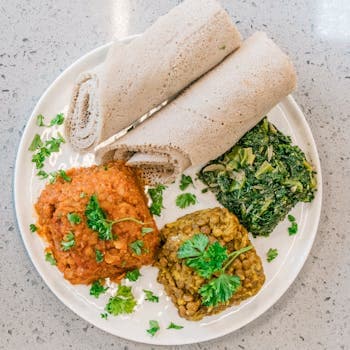
Pain plat fermenté spongieux éthiopien — la fondation de tous les repas éthiopiens.
Prépa.
30 min.
Cuisson
300 min.
Portions
8
Difficulté
Difficile
4.8
Connectez-vous pour noter#éthiopien#teff#fermenté#pain plat#fondation
Pain plat fermenté spongieux éthiopien — la fondation de tous les repas éthiopiens.
Injera est le pain plat spongieux et légèrement aigre fermenté qui forme la fondation de chaque repas éthiopien. Fabriqué à partir de farine de teff (un grain ancien), il est fermenté pendant plusieurs jours, créant une légère acidité et la miette ouverte caractéristique. Injera sert à la fois comme plaque et ustensile — la nourriture est servie sur le dessus et mangée en déchirant des morceaux d'injera pour scoop les ragoûts.
Sert 8
Mélanger la farine de teff avec de l'eau et du sel jusqu'à ce qu'une pâte fine et crêpière se forme. Couvrir.
Laisser à température ambiante pendant 3–5 jours, en remuant occasionnellement. La pâte devrait développer une légère odeur aigre (l'acidité est clé).
Les cuisines chaudes fermentent en 3 jours, les cuisines froides peuvent en avoir besoin de 5 ; goûtez une goutte – une acidité agréable signifie prêt, tandis qu’un goût farineux plat signifie attendre plus longtemps.
Chauffer une casserole antiadhésive ou une casserole injera spéciale à feu moyen-élevé. Verser la pâte dans un mouvement circulaire pour couvrir toute la casserole finement.
Ne graissez jamais la poêle – l’injera doit prendre à la vapeur sur une surface sèche et l’huile empêche la formation d’yeux.
Couvrir avec un couvercle et cuire pendant 1–2 minutes jusqu'à ce que le dessus soit défini et ait de petits trous (yeux). Le fond ne devrait pas brunir. Retirer dans une assiette.
Empiler l'injera fini sur une assiette tapissée de tissu.
Tout ce qu'il faut pour planifier votre semaine — gratuit
Cuisinez les mains libres
Profitez de plans de repas IA, d'un mode cuisine pas à pas et de vos recettes enregistrées dans l'appli gratuite Bento.
Le temps de fermentation varie selon la température — fermentation plus longue = plus aigre.
Une casserole injera dédiée donne les meilleurs résultats, mais antiadhésive fonctionne.
Cuire d’un seul côté et ne jamais retourner ; le dessous pâle et doux est ce qui rend l'injera suffisamment souple pour se plier et se déchirer.
Le temps de fermentation suit la température : 3 jours dans une cuisine chaude, jusqu'à 5 jours dans une cuisine froide. L’odeur aigre et les bulles comptent plus que le calendrier.
Le teff ivoire donne un injera plus doux et plus léger ; Le teff brun est plus terreux et plus traditionnel – un mélange 50/50 est un bon point de départ.
Utiliser farine tout usage mélangée à teff (plus facile mais moins authentique).
Ajouter berbère à la pâte pour injera épicée.
Sorgho ou orge injera : variantes régionales courantes en Ethiopie où le teff est cher ; fermenter et cuire à l’identique.
Sapin : déchirez l'injera d'un jour en morceaux et mélangez-le avec de la sauce berbere et du nitre kibbeh - la façon classique d'utiliser les restes, mangés avec de l'injera fraîche.
Mieux mangé frais, mais réfrigérer jusqu'à 3 jours enveloppé dans du tissu.
Injera a été fabriqué en Éthiopie pendant des milliers d'années. Teff est originaire d'Éthiopie et a été cultivé là depuis l'Antiquité.
Épiceries africaines, magasins d'aliments naturels ou en ligne. Teff devient de plus en plus disponible dans le monde entier.
Trois coupables habituels : la pâte est trop épaisse (elle doit couler comme une pâte à crêpe fine), la fermentation est trop courte (pas de gaz, pas de bulles), ou encore la poêle est trop froide lorsque la pâte atterrit. Corrigez d’abord l’épaisseur – la plupart des débutants rendent la pâte beaucoup trop lourde – puis donnez à la fermentation un autre jour.
Le teff pur injera est naturellement sans gluten, puisque le teff ne contient pas de gluten – l’une des raisons pour lesquelles cette céréale a gagné en popularité à l’échelle internationale. Mais attention : de nombreux restaurants et recettes rapides étendent le teff avec de la farine de blé ou d'orge pour réduire les coûts, les cœliaques devraient donc toujours confirmer qu'il s'agit de 100 % de teff.
Cette couche aqueuse plus foncée est un sous-produit normal de la fermentation sauvage, semblable à la houe sur un levain. Remuez-le simplement dans la pâte une fois par jour. Ne jetez le lot que si vous voyez de la moisissure rose ou floue, ce qui signifie une contamination – une odeur propre et aigre est exactement ce que vous voulez.
Par portion (130g) · 8 portions totales
Demandez quoi que ce soit à notre assistant culinaire IA sur cette recette : substitutions, techniques, mise à l'échelle.
Discutez avec AI Chef →Cette recette est présentée dans les guides sélectionnés suivants :
Rejoignez la conversation
Connectez-vous pour laisser un commentaire et enregistrer vos recettes préférées
Tout ce qu'il faut pour planifier votre semaine — gratuit
Un avis ou besoin d’aide ?
Nous lisons chaque e-mail et répondons sous 1 à 2 jours ouvrés.
© 2026 MyCookingCalendar. Tous droits réservés.