
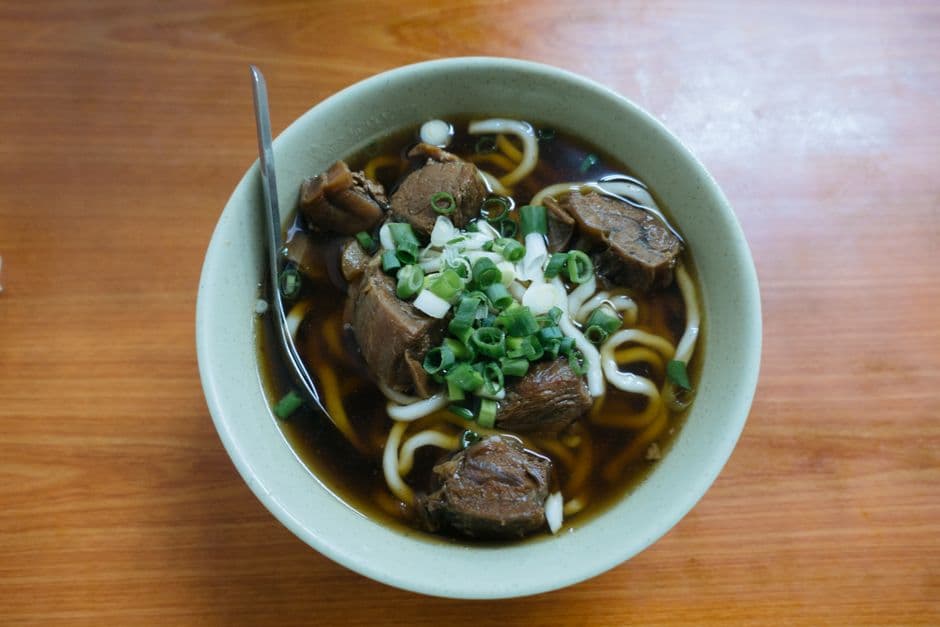
Taiwanese Beef Noodle Soup
Taiwan's national dish — a rich, spiced beef broth with tender braised beef shank and springy wheat noodles, perfumed with doubanjiang, star anise and soy.
About This Recipe
Taiwanese Beef Noodle Soup (台灣牛肉麵, niúròu miàn) is arguably Taiwan's most iconic dish and the subject of an annual competition in Taipei where hundreds of restaurants compete for the title of best bowl. The broth is built on a base of doubanjiang (spicy broad bean paste), soy sauce, Shaoxing wine and aromatic spices — star anise, cassia bark, dried tangerine peel — simmered with the braised beef shank until the meat is fall-apart tender and the broth is dark, complex and deeply savoury. Springy, thick wheat noodles are served in this magnificent broth, topped with the braised beef, pickled mustard greens (suān cài) for acidity, and fresh coriander. The dish has its roots in the Sichuan and Hunan-style red-braised beef brought to Taiwan by mainlanders who followed the Nationalist government in 1949, transformed over decades into something uniquely Taiwanese.
Ingredients
Serves 4
- 1 kgbeef shank or shin(cut into large chunks)
- 400 gthick wheat noodles(fresh or dried)
- 3 tablespoonsdoubanjiang (spicy broad bean paste)
- 4 tablespoonssoy sauce
- 2 tablespoonsdark soy sauce
- 3 tablespoonsShaoxing rice wine
- 1 tablespoonsugar
- 3star anise
- 1cassia bark or cinnamon stick
- 4 clovesgarlic(smashed)
- 3 cmfresh ginger(sliced)
- 3spring onions(plus extra to garnish)
- 1.5 litreswater or beef stock
- 100 gpickled mustard greens (suan cai)(rinsed and roughly chopped, to serve)
- 1 bunchfresh coriander(to garnish)
Instructions
- 1
Blanch the beef
Place the beef in a pot, cover with cold water and bring to a boil. Boil for 5 minutes, drain and rinse the beef under cold water. This removes blood and impurities for a cleaner broth.
- 2
Fry the doubanjiang
Heat 2 tablespoons of vegetable oil in a large heavy pot over medium heat. Add the doubanjiang and fry, stirring, for 2–3 minutes until the oil turns a deep brick red and the paste is very fragrant.
Frying the doubanjiang is the single most important step — it transforms the raw bean paste into a caramelised, complex base that gives the soup its characteristic depth and colour.
- 3
Add aromatics and build the broth
Add the garlic, ginger and spring onions and fry for 1 minute. Add the Shaoxing wine and let it sizzle. Add the soy sauces, dark soy sauce, sugar, star anise, cassia bark and water or stock. Stir to combine.
- 4
Braise the beef
Add the blanched beef to the pot. Bring to a boil, then reduce to a gentle simmer. Cover and cook for 2–2.5 hours until the beef is fork-tender and yielding. Skim excess fat from the surface during cooking.
- 5
Cook the noodles and assemble
Cook the noodles according to package instructions until al dente. Divide among bowls. Ladle over the spiced broth and top with pieces of braised beef, pickled mustard greens, sliced spring onions and fresh coriander.
Did you make this?
Rate it and help other cooks find the recipes that actually work.
One tap to sign in, and we'll save the rating you just picked.
Everything you need to plan your week — free
- Meal calendar
- Grocery list
- AI recipe ideas
Cook this hands-free
Get AI meal plans, step-by-step cooking mode, and your saved recipes in the free Bento app.
Pro Tips
- →
Beef shank gives the richest gelatinous body to the broth — do not substitute with a lean cut.
- →
The broth improves dramatically overnight — make it a day ahead for the best flavour.
- →
Pickled mustard greens (suān cài) are an essential garnish — their acidity cuts through the rich, spiced broth.
- →
Taste and adjust salt at the very end — flavors concentrate as liquids reduce, and a final pinch of flaky salt sharpens the whole dish.
Variations
- •
Clear broth version (qīng dùn niúròu miàn) omits the doubanjiang for a lighter, cleaner soup.
- •
Add a tablespoon of chilli oil to each bowl for extra heat.
- •
Vegetarian: swap the protein for roasted king oyster mushrooms, smoked tofu or cooked chickpeas — adjust seasoning slightly upward to compensate.
- •
Spicier: add a finely chopped fresh chile or a teaspoon of crushed Aleppo/Urfa pepper to the aromatics for warm, layered heat instead of a single sharp hit.
Storage
The broth and beef keep for 5 days in the fridge and freeze well for 3 months. Cook noodles fresh each time.
History & Origin
Taiwanese beef noodle soup was created by Sichuan-origin soldiers and their families who arrived in Taiwan with the Nationalist (KMT) government in 1949. They adapted their tradition of red-braised beef to Taiwanese ingredients and palates. The dish became firmly established as Taiwan's national dish by the 1970s.
Frequently Asked Questions
What is the difference between clear and red broth versions?
The red broth version (hóngshāo) uses doubanjiang for its spiced, dark colour and bold flavour. The clear version (qīng dùn) slow-braises the beef without bean paste, producing a lighter, more delicate broth. Both are considered authentic.
Can I make this ahead of time?
Yes — most of the components can be prepared up to a day in advance and refrigerated separately. Reheat gently and assemble just before serving so textures stay distinct.
What can I substitute if I don't have all the ingredients?
Stay close to the role each ingredient plays: swap aromatics for similar ones (shallot for onion, lime for lemon), and keep the fat-acid-salt balance intact. Spice blends can usually be approximated with what's in the cupboard.
How do I know it's authentic?
Authenticity sits on a spectrum — what matters more is honoring the technique and balance of flavors. If the dish tastes harmonious and respects how cooks in its home region would build it, you're on solid ground.
Nutrition Facts
Per serving (650g / 22.9 oz) · 4 servings total
Time Summary
Have Questions?
Ask our AI cooking assistant anything about this recipe — substitutions, techniques, scaling.
Chat with AI Chef →Featured in Guides
This recipe is featured in the following curated guides:
More Taiwanese Recipes
You Might Also Like
Similar dishes from other cuisines around the world.
Browse by Ingredient
More recipes built around the same core ingredients.
Free Kitchen Tools
Calculators and converters that pair with this page — no signup needed.
Put This Into a Plan
Schedule it, shop for it, and track what you already have.
Read Next
Longer reads that go deeper on the ideas behind this dish.
Community
Join the conversation
Sign in to leave a comment and save your favourite recipes