

In This Article
Track what you eat
Snap your meal to log calories and macros, run fasting timers and track water in the free SnapCal app.
Related Guides
Medical disclaimer: The information in this article is for educational purposes only. Always consult a qualified healthcare professional before making significant dietary or lifestyle changes, especially if you have a medical condition.
The 5:2 diet is one of the simplest forms of intermittent fasting to explain: you eat normally for five days of the week and sharply reduce your calories on the other two. There is no eating window to watch, no food list, and no need to think about it on a Tuesday if Tuesday is a normal day. That simplicity is the reason it became popular, and also the reason people misuse it, because "normal" days can quietly turn into an excuse to overeat and fasting days are harder than they sound. This guide explains what the pattern is, how to place your two days, what a sensible fasting day looks like on the plate, what trials have and have not shown, and who should not try it at all.
Key Takeaways
The 5:2 diet in one minute.
• Five days a week you eat as you normally would; on two non-consecutive days you eat very little, commonly described as about 500 to 600 calories. • Fasting days are not zero-calorie days. You still eat, usually one or two small, protein- and vegetable-heavy meals. • The pattern works for weight loss mainly by lowering your weekly calorie total, so what you eat on the five normal days still matters. • Space the fasting days apart (for example Monday and Thursday) rather than back to back. • It is not suitable for pregnancy, a history of eating disorders, people under 18, or anyone on glucose-lowering medication without medical supervision.
What the 5:2 pattern is, and where it came from
The 5:2 diet is a form of intermittent energy restriction. Instead of trimming a little every day, you concentrate the restriction into two days. The commonly quoted target for a fasting day is roughly 500 calories for women and 600 for men, which is around a quarter of typical daily needs for many adults. Those figures are a convention from popular books and early research, not a medical prescription, and your own needs depend on your size, age and activity.
It sits in the same family as other schedules we cover in our guide to intermittent fasting patterns. The key difference from time-restricted eating such as 16:8 is that 5:2 restricts how much you eat on certain days, not when you eat.
What the research does and does not show
Small randomized trials, including one in overweight women published in 2011, compared intermittent energy restriction with ordinary daily restriction at the same weekly calorie level. Broadly, weight loss was similar between the two approaches. Some trials reported comparable changes in markers such as insulin and blood lipids, but the studies are generally short and small, and they do not show that fasting days are metabolically special.
The honest reading is that 5:2 works when it reduces your weekly calories and you can keep doing it. It is one valid way to create a calorie deficit, not a shortcut around one. If you want the underlying mechanics, see our explainer on how a calorie deficit works. Long-term data on 5:2 specifically, beyond a year or so, are limited.
How to place your two fasting days
Choose two days that are not consecutive, such as Monday and Thursday. Back-to-back fasting days are harder to tolerate and leave little recovery in between. Pick days that are predictable and low-stress: avoid days with hard training sessions, long drives, big work deadlines or social meals.
Most people do best by fixing the days in advance and keeping them the same each week, because a pattern that moves around is a pattern that gets skipped. If your week is irregular, consider anchoring the fasting days to a routine you do not change, like the days you work from home. You can mark them on a fasting timer and log so the schedule lives somewhere other than your memory.
Tell the people you eat with about your fasting days. Most failed fast days are social, not physical.
Everything you need to plan your week — free
- Meal calendar
- Grocery list
- AI recipe ideas
What to eat on a fasting day
With only 500 to 600 calories to use, every one of them has to work hard. Build meals around lean protein, vegetables and a little fat, because protein and fiber are the most filling nutrients per calorie. Typical patterns are two small meals (a late breakfast and an early dinner) or three very small ones, plus unlimited water, black coffee and unsweetened tea.

Good building blocks include eggs, plain yogurt, fish, chicken, tofu, beans, and large volumes of low-calorie vegetables. A pot of vegetable soup is a classic fasting-day choice because a big bowl is filling for few calories, and a Greek salad with a small portion of protein can make a satisfying second meal. Avoid spending your whole allowance on one calorie-dense item, because the hunger that follows is hard to ride out.
Cook the soup the night before. A fasting day that starts with food already prepared is far easier to finish.
A sample fasting day and a sample normal day
Sample fasting day (roughly 500 to 600 calories):
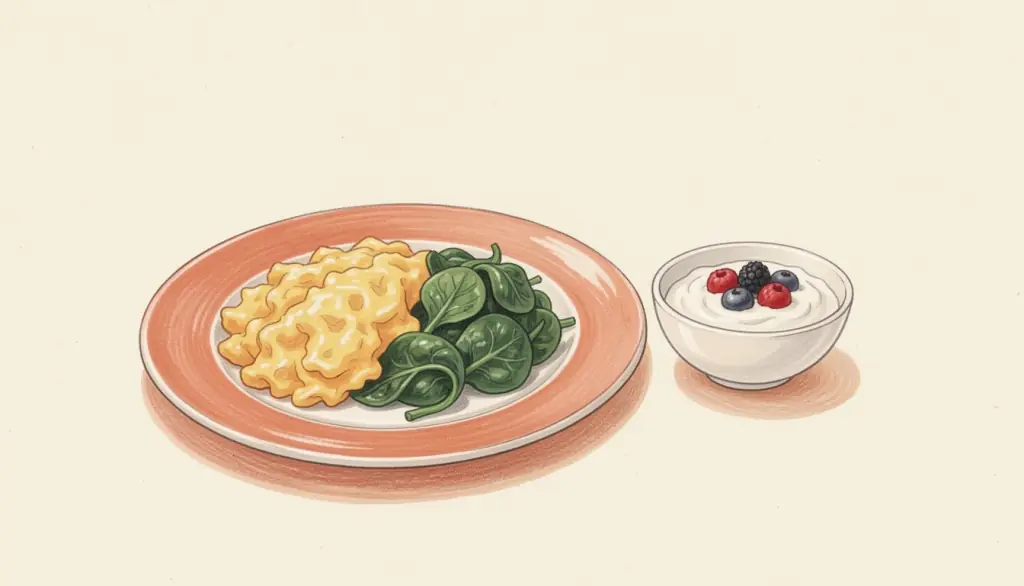
• Late morning: two eggs scrambled with spinach, black coffee • Afternoon: water, tea, or a small piece of fruit if you are hungry • Early evening: a large bowl of vegetable soup with a small portion of grilled fish or chicken and a handful of salad
Sample normal day: ordinary meals you would eat anyway, built around vegetables, protein and whole grains. The point of a normal day is to eat sensibly, not to compensate. Many people on 5:2 stall because fasting days save 1,500 or so calories and a few indulgent normal days hand them back. A weekly meal plan that lays out both kinds of day side by side makes this easy to see.
Common mistakes and how to avoid them
The most common mistake is overeating on the day after a fast. Hunger is often lower than people expect, and the reward-meal habit erases the deficit. Eat a normal, balanced breakfast instead and carry on.
Second, relying on low-nutrient foods for the fast day. Crackers and diet drinks are filling for a moment and leave you hungry and irritable by evening. Third, under-hydrating: much of the headache and fatigue people feel on fast days is mild dehydration, so drink water throughout. Our guide to hydration during intermittent fasting covers what counts and what does not. Finally, do not combine fasting days with intense workouts; keep exercise light on those days.
Hunger on a fasting day tends to come in waves rather than building steadily. It often peaks around your usual mealtimes and then fades, so the trick is to have something to do at those moments: a walk, a task, a hot drink. Many people find the second fasting day easier than the first once they know the feeling will pass.
Spread your small meals so you are not eating everything at once, and put most of your protein early, since protein is the most filling. Keep salt in your food if you feel lightheaded, and sleep properly the night before. Feeling a bit flat is normal. Feeling dizzy, shaky, confused or unwell is not, and is a signal to eat something and end the fast for that day.
It also helps to prepare. Cook a big batch of soup the day before, keep washed vegetables ready to eat, and clear tempting snacks from sight. Fasting days go wrong far more often because the food was not ready than because willpower ran out.
How to know if 5:2 is working
Judge the pattern over weeks, not days. Weight can swing by a pound or two from water and food volume, especially after a fasting day, so weigh at the same time on the same weekday and look at the trend. Pair the scale with other signals: how your clothes fit, your energy, your sleep and your mood.
If you are not losing weight after a month, add up what you actually eat across the whole week. The usual culprits are fasting days that quietly creep above the target, and normal days that grow to make up for them. Adjust one thing at a time. If you feel consistently exhausted, irritable or preoccupied with food, that is useful information too, and a gentler approach is a perfectly reasonable conclusion.
Who should not do the 5:2 diet
Fasting days are not appropriate for everyone. Do not try this pattern if you are pregnant or breastfeeding, under 18, underweight, or have a history of an eating disorder, because restriction can trigger relapse. People who take insulin or other glucose-lowering medication risk low blood sugar on fasting days and need medical guidance before changing how they eat. The same applies if you have a chronic condition, take regular medication, or are recovering from illness or surgery.
The tolerance for very low-calorie days also varies. Some women report that fasting days disrupt their cycle or sleep; if that happens, stop. Talk to your doctor or a registered dietitian before starting, especially if any of the above applies, and see our article on fasting for women for more on how hormones can interact with fasting.
The 5:2 diet suits people who dislike thinking about food every day and who can tolerate a couple of hungry-ish days. It tends to suit those with predictable weekly schedules. It is a poor fit if you have a demanding physical job, train hard on most days, or find that restriction leads to bingeing.
If you try it, run it as a four-week experiment. Track weight, energy and mood, and note how the fasting days really feel. If you are not losing weight, the problem is almost always the weekly total, not the schedule. If it makes you miserable, a gentler approach, such as a modest daily deficit or a daily eating window, may serve you better and gets you to the same place.
Key Takeaways
The 5:2 diet is a legitimate, simple way to lower your weekly calories, with research suggesting it performs about as well as ordinary dieting rather than better. Pick two non-consecutive days, plan small, protein-rich meals in advance, drink plenty of fluid, and keep your normal days sensible. And if it is not safe or comfortable for you, choose a different approach; the best diet is the one you can sustain.
Frequently Asked Questions
How many calories should I eat on 5:2 fasting days?▼
Can I exercise on fasting days?▼
Will 5:2 slow my metabolism?▼
Can I have coffee on fasting days?▼
How long until I see results?▼
References
- [1]Harvie MN, Pegington M, Mattson MP, et al. (2011). “The effects of intermittent or continuous energy restriction on weight loss and metabolic disease risk markers: a randomized trial in young overweight women.” International Journal of Obesity.
- [2]U.S. Department of Agriculture and U.S. Department of Health and Human Services (2020). “Dietary Guidelines for Americans, 2020-2025.” Government publication. Link
More in Intermittent Fasting
View all



Free Kitchen Tools
Calculators and converters that pair with this page — no signup needed.
About This Article
Written by Elena Vasquez, Health & Nutrition Writer. Published November 12, 2026. Updated November 12, 2026.
This article cites 2 peer-reviewed sources. See the full reference list below.
Editorial policy: Articles are drafted with the help of AI tools, link to the sources they rely on, and are updated when we find an error or newer evidence. Health articles are general information, not medical advice.
About the Author
Covers metabolic health, intermittent fasting and the gut microbiome, focused on summarising evidence in plain language.