
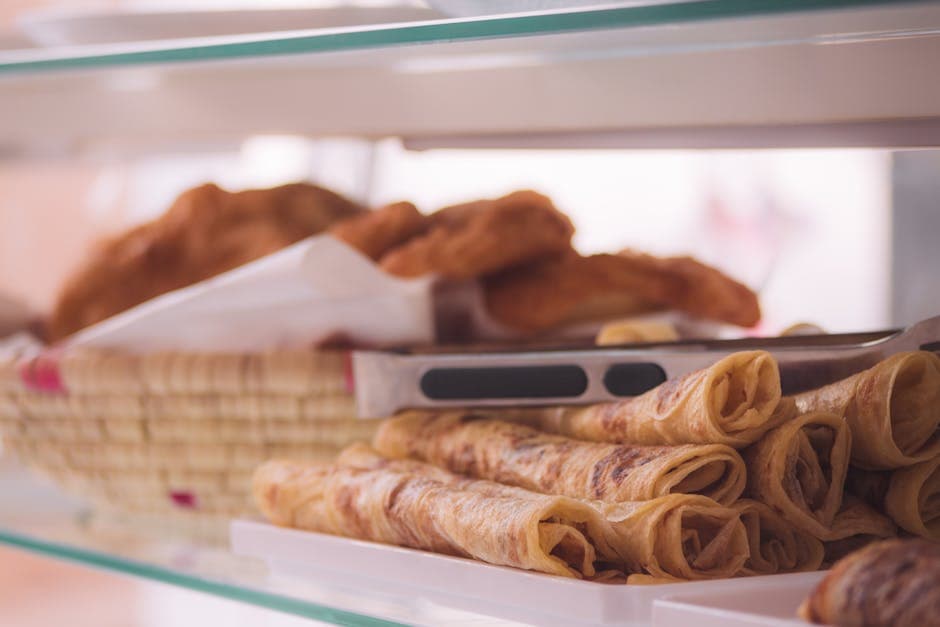
Feteer Meshaltet (Egyptian Layered Flaky Pastry)
Egypt's pharaonic layered pastry: paper-thin dough folded with ghee into hundreds of flaky leaves, baked golden and served with honey or cheese.
About This Recipe
Feteer meshaltet is one of the world's oldest pastries — a layered flatbread documented on the walls of pharaonic tombs from over 4000 years ago, where it was offered to the gods at the temples of Karnak and Luxor. The technique survives almost unchanged in modern Egypt: a soft dough is rested, stretched on an oiled marble slab into a sheet so thin you can read newspaper through it, brushed with melted ghee, folded into a square parcel, and rolled out again — sometimes 5 or 6 times — to build hundreds of microscopic layers. Baked in a wood-fired oven (or hot domestic oven) it turns crisp, deeply golden, and incredibly flaky, with paper-thin leaves that shatter at the touch. It is served sweet — drenched with honey, treacle (asal aswad), or sprinkled with powdered sugar — or savory, filled with feta, pastrami, or sausage. In rural Upper Egypt it is the celebration bread for births, weddings, and Ramadan.
Ingredients
Serves 6
- 500 gall-purpose flour, plus extra for dusting
- 1 tspfine salt
- 1 tspsugar
- 1 tbspvegetable oil
- 320 mlwarm water, approximately
- 250 gghee (samna baladi), melted but cooled
- 120 mlvegetable oil, for stretching
- 60 mlhoney or treacle, for serving
- 30 gpowdered sugar, for dusting
- 120 mlwarm milk + clotted cream (eshta), optional, for serving
Instructions
- 1
Mix and rest the dough
Combine flour, salt, sugar, vegetable oil, and warm water. Knead 8 minutes until smooth and very soft — softer than bread dough. Cover and rest 60 minutes at room temperature. The long rest is non-negotiable.
- 2
Divide and oil
Divide dough into 4 balls. Roll each in a generous coat of vegetable oil and leave them in a small bowl of oil for 15 more minutes — the oil starts to penetrate the surface and helps stretching.
- 3
Stretch ultra-thin
Pour the remaining oil onto a smooth marble or steel work surface. Working with one ball at a time, press and stretch with oiled palms in all directions into a 60 cm square so thin you can see the surface through it. Small holes are normal.
If the dough won't stretch, it's under-rested — give it another 20 minutes. Never stretch with a rolling pin; only hands.
- 4
Brush with ghee
Brush the entire stretched sheet generously with melted ghee — every square centimeter. Don't be stingy; this is what builds the layers.
- 5
Fold into a parcel
Fold the right edge of the sheet to the center, then the left edge to overlap. Now fold the top down to the center and the bottom up — you have a small square parcel about 15 cm wide. Brush the surface with ghee.
- 6
Repeat layering
Re-stretch the parcel to a 40 cm square (it will still be thin but slightly thicker than before), brush with ghee, and fold into a parcel again. Repeat the stretch-brush-fold once more (3 stretches total). This builds hundreds of layers.
- 7
Final shape
Stretch each parcel one last time into a 25 cm round, about 5 mm thick. Place on a parchment-lined baking sheet.
- 8
Bake hot
Bake at 250°C (or as hot as your oven goes) on the lower rack for 15 minutes until deeply golden and visibly puffed in layers. Then move to the upper rack for 5 more minutes to crisp the top. Serve immediately with honey poured over and a dusting of powdered sugar — or with milk and cream for the classic 'feteer bil eshta' breakfast.
Did you make this?
Rate it and help other cooks find the recipes that actually work.
One tap to sign in, and we'll save the rating you just picked.
Everything you need to plan your week — free
- Meal calendar
- Grocery list
- AI recipe ideas
Track what you eat
Snap your meal to log calories and macros, run fasting timers and track water in the free SnapCal app.
Pro Tips
- →
Real samna baladi (Egyptian buffalo-milk ghee) gives the unmistakable flavor — supermarket ghee works as substitute but lacks the slight tang.
- →
Don't shortcut the resting — under-rested dough cannot stretch translucent, and the layers will be thick and bready instead of paper-thin.
- →
Bake on the hottest rack — feteer wants intense bottom heat to puff the layers. If your oven only goes to 220°C, give it 5 extra minutes.
Variations
- •
Savory feteer: tuck thinly sliced pastrami, crumbled feta, or cooked sausage into the final fold for a meal-version.
- •
Feteer bil eshta we'asal: Egyptian breakfast style — torn pieces topped with clotted cream and dark honey.
- •
Mini feteer: divide dough into 8 balls instead of 4 for individual portions, easier to handle for beginners.
Storage
Best eaten warm from the oven. Leftover feteer keeps wrapped at room temperature for 1 day; refresh in a 200°C oven for 5 minutes to restore flakiness. Don't refrigerate — it goes leathery.
History & Origin
Feteer meshaltet is depicted on the walls of pharaonic tombs from the Old Kingdom (c. 2500 BCE), where it was prepared as an offering for the gods in the temples of Karnak and Luxor. The technique of folding oiled dough into many layers is one of the oldest documented baking methods in human history. It remains the celebration bread of rural Upper Egypt, where it is served at every wedding, birth, and major Islamic holiday.
Frequently Asked Questions
Why won't my dough stretch thin?
Almost always under-rested or over-floured. Give the dough at least an hour at room temperature, and use oil — not flour — on your work surface. Flour stops the stretch; oil enables it.
Is feteer the same as croissant or filo?
No — croissant uses butter and yeast layering; filo is stretched without folding and baked dry. Feteer is a folded, stretched, ghee-laminated dough — older than both, and unique.
Can I freeze feteer?
Freeze after the final shaping but before baking, wrapped tight. Bake from frozen at 250°C, adding 5 minutes. Don't freeze cooked feteer — it loses all its flakiness.
Nutrition Facts
Per serving (180g / 6.3 oz) · 6 servings total
Time Summary
Have Questions?
Ask our AI cooking assistant anything about this recipe — substitutions, techniques, scaling.
Chat with AI Chef →Featured in Guides
This recipe is featured in the following curated guides:
More Egyptian Recipes
You Might Also Like
Similar dishes from other cuisines around the world.
Free Kitchen Tools
Calculators and converters that pair with this page — no signup needed.
Put This Into a Plan
Schedule it, shop for it, and track what you already have.
Read Next
Longer reads that go deeper on the ideas behind this dish.
Community
Join the conversation
Sign in to leave a comment and save your favourite recipes