
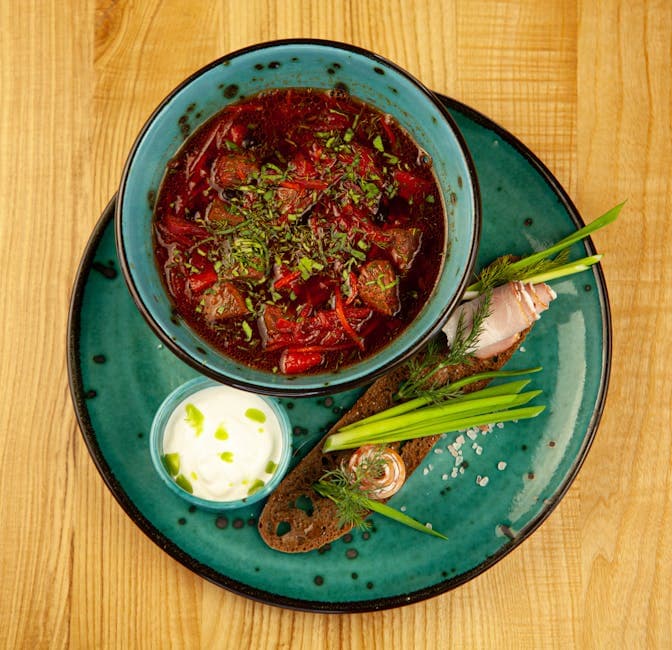
Ukrainian Borscht (Proper Traditional)
Ukraine's UNESCO-recognised national soup — beetroot, beef, beans, cabbage and roasted vegetables built into a deep crimson masterpiece served with smetana and pampushky.
About This Recipe
Borscht is the heart of Ukrainian cooking and was inscribed on UNESCO's Intangible Cultural Heritage list in 2022 specifically as a Ukrainian dish. Proper Ukrainian borscht is not the thin pink beet soup many Westerners imagine — it's a deeply layered, almost stew-like soup built on a beef-bone broth that simmers for hours, then thickened with sautéed beetroot, carrot, onion and tomato (the 'zazharka'), and finished with white cabbage, white beans, potato, and a final crucial splash of beet-vinegar 'kvas' or vinegar to keep the colour a vivid crimson. Each Ukrainian region — and every Ukrainian babusia — has her own recipe: Poltava style includes dumplings; Galician style adds dried plums; Chernihiv style uses zucchini in summer. What unites them is the layering technique, the use of fresh beetroot rather than canned, and the requirement that the soup rest at least one full day before eating — borscht is one of the few dishes where the second-day version is genuinely better than the first. It's served with thick slices of dark rye bread, a generous spoon of smetana stirred in at the table, a head of raw garlic on the side to bite between spoonfuls, and pampushky — soft garlic-rubbed yeast rolls — for soaking up the broth.
Ingredients
Serves 8
- 1.2 kgbeef short rib or beef shin on the bone, plus 1 marrow bone if available
- 3 Lcold water
- 500 gfresh red beetroot (about 3 medium), peeled and grated coarsely
- 2 largecarrots, grated; 2 onions, finely chopped; 3 garlic cloves, minced
- 400 gwhite cabbage, finely shredded
- 3 mediumwaxy potatoes, peeled and diced 1.5 cm
- 1 400 g tinwhite beans (cannellini), drained — or 150 g dried, soaked overnight and pre-cooked
- 3 tbsptomato paste; 2 ripe tomatoes (or 200 g tinned), chopped
- 3 tbspwhite wine or apple cider vinegar; 1 tbsp sugar; 2 bay leaves; 1 tsp peppercorns; salt to taste
- 200 mlsmetana or full-fat sour cream, a handful fresh dill, and a head of raw garlic, to serve
Instructions
- 1
Build a deep beef broth
Place the beef short rib, marrow bone, bay leaves and peppercorns in a large pot with 3 L cold water. Bring slowly to a bare simmer (this takes about 30 minutes) and skim off all the grey foam that rises. Simmer very gently 2 hours until the beef is tender. Lift the beef out, shred when cool enough to handle, and reserve. Strain the broth and return to a clean pot.
- 2
Make the zazharka (the heart of borscht)
While the broth simmers, heat 3 tbsp oil in a wide skillet over medium heat. Sweat the onion 6 minutes until soft. Add the grated carrot and cook 5 more minutes. Add the grated beetroot, tomato paste, chopped tomatoes, sugar, and 1 tbsp of the vinegar. Cover and braise 20 minutes — the beetroot should soften and turn deep ruby, the vegetables glossy and jammy.
The vinegar in the zazharka 'fixes' the beet colour — without it your borscht will go brown when cooked.
- 3
Cook potatoes in the broth
Bring the strained beef broth to a steady simmer. Add the diced potatoes and cook 10 minutes until just becoming tender — they'll finish cooking in the next stage.
- 4
Add cabbage and beans
Add the shredded cabbage and white beans to the broth with the potatoes. Cook 8 minutes until the cabbage is soft but still has a slight bite. Season with 1.5 tsp salt to start.
- 5
Bring it together
Tip the entire zazharka (the beet-onion-carrot-tomato mixture) into the broth and stir gently. Add the shredded beef back in. Add the second tablespoon of vinegar and the minced garlic. Simmer 10 minutes — long enough for the flavours to marry, but not so long that the cabbage turns to mush.
- 6
Taste and balance
This is the critical step. Borscht should taste sweet-sour-savoury all at once. Add salt (probably another teaspoon), a splash more vinegar if too sweet, a pinch more sugar if too sour. The colour should be deep crimson, not brown — if it's gone brown, you can revive it with another teaspoon of vinegar.
- 7
Rest at least 4 hours, preferably overnight
Pull the pot off the heat and let it cool to room temperature, then refrigerate at least 4 hours, ideally overnight. This rest is essential — borscht eaten straight after cooking is a shadow of the next-day version. The flavours need to settle and the colour to deepen.
- 8
Reheat and serve in the Ukrainian way
Reheat gently to just-steaming (don't boil — preserves colour). Ladle into deep bowls. Each diner stirs in a generous spoon of smetana to swirl, scatters chopped fresh dill on top, and traditionally bites between spoons of soup and a whole raw garlic clove crushed onto a piece of dark rye bread or a pampushka.
Did you make this?
Rate it and help other cooks find the recipes that actually work.
One tap to sign in, and we'll save the rating you just picked.
Everything you need to plan your week — free
- Meal calendar
- Grocery list
- AI recipe ideas
Cook this hands-free
Get AI meal plans, step-by-step cooking mode, and your saved recipes in the free Bento app.
Pro Tips
- →
Always use FRESH raw beetroot, never canned — canned beets are too sweet and lack the earthy depth. Grate, don't dice, for the smoothest integration into the broth.
- →
The vinegar in the zazharka is non-negotiable — it 'fixes' the beet pigment and keeps the borscht crimson. Without it, the soup goes muddy brown.
- →
Make borscht a full day ahead. Same-day borscht is OK; second-day borscht is transcendent. Third-day borscht is even better. The flavours melt and deepen in the fridge.
- →
Add the garlic at the end (last 10 minutes only) — long-cooked garlic loses its punch. The classic Ukrainian flourish is also to crush a raw garlic clove into each bowl right before eating.
Variations
- •
Lenten borscht — skip the beef, build broth on dried wild mushrooms (porcini) and root vegetables; common during Orthodox fasting periods.
- •
With pampushky — bake garlic-rubbed yeast rolls in the same oven the borscht reheats in; the canonical Ukrainian bread accompaniment.
- •
Cold summer borscht (kholodnyk) — same building blocks but served chilled with diced cucumber, hard-boiled egg, and lots of dill; the Ukrainian summer answer to gazpacho.
- •
With prunes — add 8 pitted prunes in the last 15 minutes for the Galician-style sweet-savoury depth common in western Ukraine.
Storage
Borscht keeps 5 days refrigerated and is better every day. Freezes well 3 months — freeze in single-portion containers. Reheat gently on the stove (microwaving partially destroys the colour and breaks the cabbage texture). Never boil after the initial cook.
History & Origin
Borscht originated among the Slavs of Kyivan Rus' over a thousand years ago, originally as a soup made from fermented hogweed stems (the word 'borscht' descends from the Slavic word for hogweed). Beetroot replaced hogweed by the 16th century, and the dish was inscribed on UNESCO's Intangible Cultural Heritage list in July 2022 as a Ukrainian national dish requiring safeguarding.
Frequently Asked Questions
Can I use canned beetroot?
It's strongly discouraged — canned beets are pre-cooked and too sweet, and the soup loses the earthy depth. If absolutely necessary, use jarred raw beetroot in vinegar (sold in Eastern European groceries) as a closer substitute.
Why is my borscht brown, not red?
The beet pigment broke down because you didn't add enough vinegar with the beetroot (or you boiled too hard). Add another teaspoon of vinegar at the end and a pinch of sugar to balance — the colour will revive partially.
Is borscht Russian or Ukrainian?
It is Ukrainian — UNESCO recognised it in 2022 specifically as a Ukrainian dish requiring safeguarding. Versions exist throughout the broader Slavic world (Poland, Belarus, Russia) but the origin and the strongest cultural roots are Ukrainian.
Do I really need to rest it overnight?
Yes — borscht is one of the few dishes where 'better the next day' isn't a cliché. The flavours integrate, the beet colour deepens, and the soup tastes meaningfully different. Always make a day ahead if you can.
Nutrition Facts
Per serving (480g / 16.9 oz) · 8 servings total
Time Summary
Have Questions?
Ask our AI cooking assistant anything about this recipe — substitutions, techniques, scaling.
Chat with AI Chef →Featured in Guides
This recipe is featured in the following curated guides:
More Ukrainian Recipes
You Might Also Like
Similar dishes from other cuisines around the world.
Free Kitchen Tools
Calculators and converters that pair with this page — no signup needed.
Put This Into a Plan
Schedule it, shop for it, and track what you already have.
Read Next
Longer reads that go deeper on the ideas behind this dish.
Community
Join the conversation
Sign in to leave a comment and save your favourite recipes