
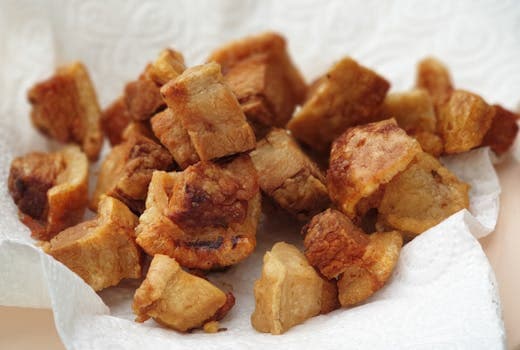
Lechon Kawali (Porc Croustillant Frit)
La réponse philippine au porc croustillant : poitrine de porc bouillie puis frite jusqu'à ce que la peau se brise comme du verre, servie avec une sauce au foie et du riz.
À propos de cette recette
Lechon kawali est l'équivalent philippin du siu yuk cantonais (rôti de porc croustillant) et du dong po rou chinois, mais frit plutôt que rôti. Une tranche de poitrine de porc est d'abord bouillie avec de l'ail, des feuilles de laurier, des grains de poivre et du sel jusqu'à ce qu'elle soit bien cuite, puis réfrigérée à découvert pour que la peau sèche complètement. Lorsqu'elle est frite à haute température, la peau séchée se transforme en une série de bulles spectaculaires et crépitantes qui se brisent à la moindre pression. Le contraste entre la peau croustillante et la viande tendre et grasse en dessous est profondément satisfaisant. Il est traditionnellement servi avec une sauce lechon (une sauce aigre-douce à base de foie) ou simplement avec du vinaigre et du calamansi (citron vert philippin). Enraciné dans la cuisine quotidienne des cuisines philippines, le Lechon Kawali (ventre de porc frit croustillant philippin) équilibre technique et tradition : la poitrine de porc, avec la peau, en un seul morceau est traitée avec soin, en s'appuyant sur des proportions séculaires que les habitants ont affinées au fil des générations. Le plat porte une signature sensorielle indubitable : des arômes qui remplissent la cuisine pendant la cuisson, des textures superposées qui se révèlent bouchée par bouchée et une profondeur de saveur qui vient d'un assaisonnement patient plutôt que de raccourcis. Qu'il soit servi comme dîner de semaine ou comme pièce maîtresse d'une table de fête, il reflète un garde-manger régional où les produits locaux, les habitudes d'assaisonnement et les récipients de cuisson façonnent le résultat final. Les cuisiniers amateurs qui préparent ce plat notent souvent à quel point il est indulgent une fois la méthode de base comprise, et comment quelques petits choix — la fraîcheur de la poitrine de porc, avec la peau, en un seul morceau, l'ordre des ajouts, le temps de repos à la fin — séparent une bonne version d'une version mémorable. Cette recette passe en revue ces choix pour que le plat arrive avec le caractère qu'il a sur son terrain d'origine.
Ingrédients
Sert 6
- 1 kgpoitrine de porc, avec la peau, en un seul morceau
- 6gousses d'ail, écrasées
- 3feuilles de laurier
- 1 c. à s.grains de poivre entiers
- 2 c. à s.sel
- 2 litreshuile végétale pour la friture
- vinaigre ou jus de calamansi pour servir
Étapes
- 1
Bouillir la poitrine de porc
Placer la poitrine de porc dans une casserole avec l'ail, les feuilles de laurier, les grains de poivre et le sel. Couvrir d'eau. Faire bouillir pendant 45 à 60 minutes jusqu'à ce qu'ils soient bien cuits et tendres. Vidange.
- 2
Sécher la peau
Séchez le porc. Placer côté peau vers le haut sur une grille au réfrigérateur, à découvert, pendant au moins 4 heures ou toute la nuit. La peau doit être complètement sèche et comme du papier.
- 3
Frire
Chauffer l'huile dans une grande casserole à fond épais à 180°C (355°F). Abaissez délicatement la poitrine de porc, côté peau vers le bas, dans l'huile chaude. Faites frire pendant 15 à 20 minutes, en retournant de temps en temps, jusqu'à ce que la peau soit dorée et couverte de bulles crépitantes spectaculaires.
- 4
Égoutter et laisser reposer
Égoutter sur une grille pendant 5 minutes. Ne pas placer sur du papier absorbant – la vapeur adoucit les crépitements.
- 5
Hacher et servir
Coupez-le en morceaux avec un couteau épais ou un couperet. Servir avec du riz vapeur, du vinaigre ou une sauce lechon.
Vous l'avez cuisinée ?
Notez-la et aidez les autres à trouver les recettes qui fonctionnent vraiment.
Connectez-vous en un geste : nous enregistrons la note que vous venez de choisir.
Tout ce qu'il faut pour planifier votre semaine — gratuit
- Calendrier des repas
- Liste de courses
- Idées de recettes IA
Cuisinez les mains libres
Profitez de plans de repas IA, d'un mode cuisine pas à pas et de vos recettes enregistrées dans l'appli gratuite Bento.
Conseils de pro
- →
Le séchage de la peau est l’étape critique : même 30 minutes au réfrigérateur font la différence. La nuit est idéale.
- →
L'huile doit être suffisamment chaude – testez avec un petit morceau de couenne de porc. Il devrait grésiller immédiatement.
- →
Utilisez un pare-éclaboussures ou faites frire à l’extérieur – l’huile crache vigoureusement.
- →
Procurez-vous la poitrine de porc la plus fraîche, avec la peau, en un seul morceau que vous puissiez trouver – c'est le point d'ancrage de la saveur du plat.
- →
Assaisonner en couches au fur et à mesure; la dégustation à chaque étape évite un résultat final plat ou trop salé.
Variantes
- •
Lechon sa hurno : rôtir la poitrine de porc séchée à 230°C pour une alternative moins grasse.
- •
Assaisonnez l’eau bouillante avec de la citronnelle pour une version parfumée façon Ilocano.
- •
Végétarien : remplacez la protéine principale par des champignons, du paneer, du tofu ou des haricots copieux pour une version sans viande.
- •
Plus épicé : ajoutez du piment frais, une pâte de piment ou une pincée de poivre de Cayenne avec les aromates pour un profil plus chaleureux.
- •
Plus léger : réduisez la graisse d'un tiers et utilisez du bouillon à la place : la saveur reste intacte mais le plat semble moins riche.
Stockage
Mieux mangé immédiatement. Les crépitements s'adoucissent en quelques heures. Réfrigérer dans un contenant hermétique jusqu'à 3 à 4 jours. Réchauffez doucement sur la cuisinière à feu doux avec un peu d'eau ou de bouillon pour desserrer, ou passez au micro-ondes à 60 % de puissance couverte pour qu'il se réchauffe sans sécher. Se congèle bien jusqu'à 2 mois dans des contenants portionnés ; décongeler toute la nuit au réfrigérateur avant de réchauffer. Les plats à base de produits laitiers ou d'éléments frits peuvent changer de texture après la congélation – rafraîchissez-les avec une garniture croustillante.
Histoire et origine
Lechon (de l'espagnol lechón, cochon de lait rôti) est au cœur des célébrations philippines. Lechon kawali (« lechon poêlé ») a été développé pour remplacer le porc entier rôti dans les repas de tous les jours – la même satisfaction de peau croustillante sans rôtir un porc entier.
Foire aux questions
Puis-je préparer du Lechon Kawali (poitrine de porc frite croustillante philippine) à l'avance ?
Oui, la plupart des composants se conservent bien au réfrigérateur pendant un jour ou deux. Réchauffez doucement avec un peu de liquide pour lui redonner vie.
Par quoi puis-je remplacer la poitrine de porc, avec la peau, en un seul morceau ?
Si la poitrine de porc, avec la peau, en un seul morceau est difficile à trouver, les substituts les plus proches partagent sa texture et sa teneur en eau. Ajustez légèrement l'assaisonnement, car les substituts ont souvent moins de caractère.
Cette recette est-elle authentique de la cuisine philippine ?
Il suit le modèle de cuisine maison le plus largement accepté. Des variantes régionales existent et nous notons les principales dans la rubrique variantes.
Pourquoi ma version est-elle devenue fade ?
Généralement sous-assaisonné ou précipité la phase aromatique. Créez de la saveur en couches, goûtez au fur et à mesure et terminez avec une touche d'acide ou de sel pour égayer le plat.
Faits nutritionnels
Par portion · 6 portions totales
Résumé du temps
Vous avez des questions ?
Demandez quoi que ce soit à notre assistant culinaire IA sur cette recette : substitutions, techniques, mise à l'échelle.
Discutez avec AI Chef →Plus de recettes philippines
Vous Aimerez Aussi
Des plats similaires venus d'autres cuisines du monde.
Parcourir par Ingrédient
D'autres recettes construites autour des mêmes ingrédients principaux.
Outils de Cuisine Gratuits
Calculateurs et convertisseurs qui accompagnent cette page — sans inscription.
Transformer en Plan
Programmez-le, faites les courses et suivez ce que vous avez déjà.
À Lire Ensuite
Des articles de fond sur les idées derrière ce plat.
Communauté
Rejoignez la conversation
Connectez-vous pour laisser un commentaire et enregistrer vos recettes préférées