
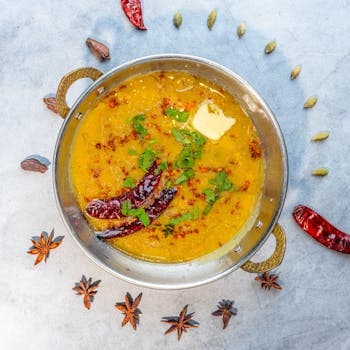
Dal Tadka (Lentilles jaunes punjabi au beurre épicé)
Le plat de lentilles quotidien le plus aimé de l'Inde — lentilles jaunes cuites jusqu'à crémeux et garni d'une tadka ghee épicée grésillante au cumin ail piment sec et tomate. Qualité restaurant en 30 minutes.
À propos de cette recette
Le Dal Tadka est la pierre angulaire de la cuisine familiale indienne – un plat tellement ancré dans la vie quotidienne que la plupart des familles indiennes le mangent plusieurs fois par semaine. Le toor dal jaune (pois d'Angole cassés) ou chana dal est cuit jusqu'à ce qu'il soit complètement tendre et crémeux, puis terminé avec un tadka : du ghee chaud ou de l'huile dans laquelle des épices entières (graines de cumin, piments séchés) sont fleuries pour libérer leurs arômes liposolubles, suivies de l'ail, de l'oignon et de la tomate. Le tadka est versé sur le dal à table avec un grésillement spectaculaire, finissant le plat avec une richesse aromatique en couches que la base de dal légèrement épicée ne peut obtenir à elle seule. Le contraste entre les lentilles crémeuses et douces et le tadka intensément aromatique est ce qui rend le plat si satisfaisant et si difficile à arrêter de manger. Enraciné dans la cuisine quotidienne des cuisines indiennes, le Dal Tadka (lentilles jaunes du Pendjabi au beurre épicé) équilibre technique et tradition : le toor dal (pois d'Angole cassés) ou lentilles rouges, rincées, est traité avec soin, en s'appuyant sur des proportions séculaires que les habitants ont affinées au fil des générations. Le plat porte une signature sensorielle indubitable : des arômes qui remplissent la cuisine pendant la cuisson, des textures superposées qui se révèlent bouchée par bouchée et une profondeur de saveur qui vient d'un assaisonnement patient plutôt que de raccourcis. Qu'il soit servi comme dîner de semaine ou comme pièce maîtresse d'une table de fête, il reflète un garde-manger régional où les produits locaux, les habitudes d'assaisonnement et les récipients de cuisson façonnent le résultat final. Les cuisiniers amateurs qui préparent ce plat notent souvent à quel point il est indulgent une fois la méthode de base comprise, et comment quelques petits choix — la fraîcheur du toor dal (pois d'Angole cassés) ou des lentilles rouges rincées, l'ordre des ajouts, le temps de repos à la fin — séparent une bonne version d'une mémorable. Cette recette passe en revue ces choix pour que le plat arrive avec le caractère qu'il a sur son terrain d'origine.
Ingrédients
Sert 4
- 250 gtoor dal (pois d'Angole cassés) ou lentilles rouges, rincées
- 800 mleau
- 1 c. à c.curcuma
- 1 c. à c.sel
- Tadka (beurre épicé)
- 3 c. à s.ghee (ou beurre non salé)
- 1 c. à c.graines de cumin
- 4 goussesail, tranché finement
- 2piments rouges entiers séchés
- 1oignon moyen, haché finement
- 2tomates mûres, hachées finement
- 1 c. à c.Poudre de piment rouge du Cachemire
- 1 c. à c.garam masala
- 2 c. à s.feuilles de coriandre fraîche, pour garnir
- 1citron, coupé en quartiers, pour servir
Étapes
- 1
Cuire les lentilles
Mettre le dal rincé, l'eau, le curcuma et le sel dans une casserole. Porter à ébullition, puis laisser mijoter partiellement à couvert pendant 25 à 30 minutes jusqu'à ce qu'il soit complètement tendre et crémeux. Fouettez brièvement pour lisser les grumeaux. Ajoutez plus d'eau si nécessaire – la consistance doit être versable mais pas aqueuse. (Autocuiseur : 10 minutes à haute pression.)
- 2
Préparer le tadka
Faites chauffer le ghee dans une petite poêle à feu moyen-vif jusqu'à ce qu'il brille. Ajoutez les graines de cumin – elles devraient grésiller immédiatement. Ajouter les piments séchés, puis les tranches d'ail. Cuire 1 minute jusqu'à ce que l'ail soit doré (pas foncé).
- 3
Ajouter l'oignon et la tomate
Ajouter l'oignon coupé en dés et cuire 5 à 6 minutes jusqu'à ce qu'il soit doré. Ajouter les tomates hachées et cuire 3 à 4 minutes jusqu'à ce qu'elles soient décomposées. Incorporer la poudre de piment du Cachemire et le garam masala.
- 4
Terminer le plat
Versez le tadka grésillant directement sur les lentilles cuites. Remuez délicatement (ou laissez le tadka en couronne dessus pour la présentation). Goûtez au sel.
- 5
Serve
Garnir de coriandre fraîche et servir avec du riz basmati, du chapati ou du naan. Quartiers de citron à part.
Vous l'avez cuisinée ?
Notez-la et aidez les autres à trouver les recettes qui fonctionnent vraiment.
Connectez-vous en un geste : nous enregistrons la note que vous venez de choisir.
Tout ce qu'il faut pour planifier votre semaine — gratuit
- Calendrier des repas
- Liste de courses
- Idées de recettes IA
Cuisinez les mains libres
Profitez de plans de repas IA, d'un mode cuisine pas à pas et de vos recettes enregistrées dans l'appli gratuite Bento.
Conseils de pro
- →
Le tadka doit être très chaud lorsqu'on le verse – le grésillement n'est pas seulement dramatique, il continue la cuisson des épices et libère plus de saveur.
- →
La poudre de piment du Cachemire donne de la couleur sans chaleur excessive – remplacez-la par du paprika doux si elle n'est pas disponible.
- →
Ne précipitez pas les lentilles : elles doivent être complètement molles avant d'ajouter le tadka.
- →
Procurez-vous le toor dal (pois d'Angole cassés) ou les lentilles rouges rincées les plus frais que vous puissiez trouver - c'est le point d'ancrage de la saveur du plat.
- →
Assaisonner en couches au fur et à mesure; la dégustation à chaque étape évite un résultat final plat ou trop salé.
Variantes
- •
À la manière du Dal makhani : remplacez le toor dal par des lentilles urad noires, faites cuire toute la nuit à feu très doux, ajoutez de la crème et du beurre pour un riche dal de style restaurant punjabi.
- •
Dal fumé façon restaurant : après avoir ajouté le tadka, maintenez un morceau de charbon de bois brûlant dans un petit bol de ghee sur le dal et couvrez – la fumée infuse le dal en 2 minutes (technique dungar).
- •
Dal du sud de l'Inde : ajoutez des feuilles de curry et des graines de moutarde au tadka, utilisez de l'huile de coco à la place du ghee et ajoutez de la pâte de tamarin aux lentilles cuites.
- •
Végétarien : remplacez la protéine principale par des champignons, du paneer, du tofu ou des haricots copieux pour une version sans viande.
- •
Plus épicé : ajoutez du piment frais, une pâte de piment ou une pincée de poivre de Cayenne avec les aromates pour un profil plus chaleureux.
Stockage
Se conserve 4 jours au réfrigérateur. Épaissit en refroidissant – ajoutez de l’eau lors du réchauffage. Se congèle bien pendant 3 mois.
Histoire et origine
Le dal est l'aliment le plus ancien et le plus démocratisant d'Inde, consommé dans toutes les régions, religions et classes économiques. La technique tadka (température des épices dans la graisse) est l'une des méthodes fondamentales de la cuisine indienne, documentée dans l'ancienne philosophie alimentaire ayurvédique comme un moyen de rendre les épices plus biodisponibles en extrayant leurs composés liposolubles.
Foire aux questions
Puis-je préparer du Dal Tadka (lentilles jaunes du Pendjabi au beurre épicé) à l'avance ?
Oui, la plupart des composants se conservent bien au réfrigérateur pendant un jour ou deux. Réchauffez doucement avec un peu de liquide pour lui redonner vie.
Par quoi remplacer le toor dal (pois d'Angole cassés) ou les lentilles rouges rincées ?
Si le toor dal (pois d'Angole cassés) ou les lentilles rouges rincées sont difficiles à trouver, les substituts les plus proches partagent sa texture et sa teneur en eau. Ajustez légèrement l'assaisonnement, car les substituts ont souvent moins de caractère.
Cette recette est-elle authentique de la cuisine indienne ?
Il suit le modèle de cuisine maison le plus largement accepté. Des variantes régionales existent et nous notons les principales dans la rubrique variantes.
Pourquoi ma version est-elle devenue fade ?
Généralement sous-assaisonné ou précipité la phase aromatique. Créez de la saveur en couches, goûtez au fur et à mesure et terminez avec une touche d'acide ou de sel pour égayer le plat.
Faits nutritionnels
Par portion · 4 portions totales
Résumé du temps
Vous avez des questions ?
Demandez quoi que ce soit à notre assistant culinaire IA sur cette recette : substitutions, techniques, mise à l'échelle.
Discutez avec AI Chef →Présenté dans les guides
Cette recette est présentée dans les guides sélectionnés suivants :
collections
24 recettes de haricots et de légumineuses : riches en protéines et satisfaisantes
collections
15 plats préparés à l'avance qui se congèlent et se réchauffent vraiment bien
cuisine guides
Cuisine indienne : 50 recettes maîtrisant les épices et les techniques
meal plans
Plan de repas hyperprotéiné de la semaine : 7 jours, 100 g+ de protéines par jour
Plus de recettes indiennes
Vous Aimerez Aussi
Des plats similaires venus d'autres cuisines du monde.
Parcourir par Ingrédient
D'autres recettes construites autour des mêmes ingrédients principaux.
Outils de Cuisine Gratuits
Calculateurs et convertisseurs qui accompagnent cette page — sans inscription.
Transformer en Plan
Programmez-le, faites les courses et suivez ce que vous avez déjà.
À Lire Ensuite
Des articles de fond sur les idées derrière ce plat.
Repas végétaliens riches en protéines : 15 recettes complètes avec plus de 25 g de protéines par portion
13 min.
Régime riche en protéines pour perdre du poids : une science complète derrière cela
12 min.
Qualité des protéines : protéines complètes ou incomplètes, score DIAAS et ce qui compte réellement
14 min.
Communauté
Rejoignez la conversation
Connectez-vous pour laisser un commentaire et enregistrer vos recettes préférées