
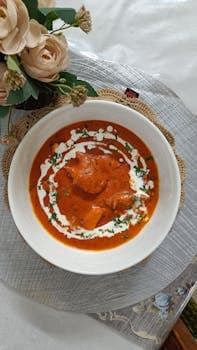
Poulet Beurre Céto
Poulet beurre riche et crémeux sans sucre ajouté ni farine.
À propos de cette recette
Tout le luxe vélouté et le confort classique du poulet beurre, rendu céto-amical — des cuisses de poulet tendres mijotées dans une sauce somptueuse de tomates, beurre, crème et épices chaleureuses, sans sucre, farine ni épaississants riches en glucides. Servi sur du riz de chou-fleur, il contient moins de 10 grammes de glucides nets par portion.
Ingrédients
Sert 4
- 600 gcuisses de poulet désossées et sans peau, en dés
- 200 mlcrème épaisse
- 200 gtomates concassées en conserve
- 60 gbeurre non salé
- 3 goussesail, haché
- 1 c. à s.gingembre frais, râpé
- 2 c. à c.garam masala
- 1 c. à c.curcuma moulu
- 1 c. à c.paprika fumé
- 1 c. à c.sel
Étapes
- 1
Saisir le poulet
Faire fondre la moitié du beurre dans une grande poêle à feu moyen-élevé. Assaisonner le poulet avec du sel et saisir par portions 2-3 minutes par côté jusqu'à doré. Transférer dans une assiette.
- 2
Préparer la sauce
Dans la même poêle, faire fondre le beurre restant. Faire sauté l'ail et le gingembre 1 minute. Ajouter le garam masala, le curcuma et la paprika, remuer 30 secondes.
- 3
Mijoter
Ajouter les tomates concassées et porter à frémissement. Cuire 5 minutes. Incorporer la crème épaisse et remettre le poulet dans la poêle. Mijoter à découvert 12-15 minutes jusqu'à ce que le poulet soit cuit et la sauce épaissie.
- 4
Ajuster et servir
Goûter et ajuster le sel et les épices. Servir sur du riz de chou-fleur ou avec du naan faible en glucides.
Vous l'avez cuisinée ?
Notez-la et aidez les autres à trouver les recettes qui fonctionnent vraiment.
Connectez-vous en un geste : nous enregistrons la note que vous venez de choisir.
Tout ce qu'il faut pour planifier votre semaine — gratuit
- Calendrier des repas
- Liste de courses
- Idées de recettes IA
Cuisinez les mains libres
Profitez de plans de repas IA, d'un mode cuisine pas à pas et de vos recettes enregistrées dans l'appli gratuite Bento.
Conseils de pro
- →
Utiliser les cuisses de poulet, pas la poitrine — elles restent plus juteuses dans la sauce.
- →
Laisser la sauce mijoter assez longtemps pour épaissir sans ajouter de farine.
- →
Un mixeur plongeant peut lisser la sauce si on préfère une texture veloutée.
- →
Goûter et ajuster le sel à la fin — les saveurs se concentrent quand les liquides réduisent, et une pincée finale de sel floconné ravive le plat entier.
Variantes
- •
Ajouter une poignée d'épinards bébé dans les 2 dernières minutes pour plus de verdure.
- •
Remplacer la crème laitière par de la crème de coco pour la rendre sans produits laitiers.
- •
Végétarien : remplacer la protéine par des champignons roi huitre rôtis, du tofu fumé ou des pois chiches cuits — ajuster l'assaisonnement légèrement vers le haut pour compenser.
- •
Plus épicé : ajouter un piment frais finement haché ou une cuillère à café de poivre d'Alep/Urfa écrasé aux aromatiques pour une chaleur chaleureuse et stratifiée au lieu d'un coup unique et aigu.
Stockage
Conserver au réfrigérateur jusqu'à 4 jours. Congeler jusqu'à 2 mois. Réchauffer doucement sur la cuisinière.
Histoire et origine
Le poulet au beurre Keto est façonné par le commerce des épices en Inde et par le tempérage minutieux (tarka) qui libère les composés aromatiques. Les variations régionales sont la règle plutôt que l'exception : les villages voisins, les familles et même les cuisiniers individuels adaptent le plat à ce qu'il y a dans le garde-manger et à ce qui est de saison, c'est pourquoi il n'y a pas deux versions exactement identiques et pourquoi la recette est restée vivante pendant si longtemps.
Foire aux questions
Puis-je faire cela à l'avance ?
Oui — la plupart des composants peuvent être préparés jusqu'à un jour à l'avance et conservés séparément au réfrigérateur. Réchauffer doucement et assembler juste avant de servir pour que les textures restent distinctes.
Que puis-je remplacer si je n'ai pas tous les ingrédients ?
Rester proche du rôle que joue chaque ingrédient : remplacer les aromatiques par des similaires (échalote pour oignon, citron vert pour citron), et maintenir l'équilibre gras-acide-sel intacte. Les mélanges d'épices peuvent généralement être approximés avec ce qui est dans le placard.
Comment savoir si c'est authentique ?
L'authenticité se situe sur un spectre — ce qui compte davantage est d'honorer la technique et l'équilibre des saveurs. Si le plat a un goût harmonieux et respecte comment les cuisiniers de sa région d'origine le construiraient, vous êtes sur terrain solide.
Pourquoi le mien n'a pas fonctionné comme prévu ?
Les deux problèmes les plus courants sont le sous-assaisonnement et se précipiter sur la chaleur. Goûter au fur et à mesure, assaisonner par couches, et laisser aux aromatiques et aux protéines le temps de développer la couleur et la profondeur avant de passer à l'étape suivante.
Faits nutritionnels
Par portion (280g) · 4 portions totales
Résumé du temps
Vous avez des questions ?
Demandez quoi que ce soit à notre assistant culinaire IA sur cette recette : substitutions, techniques, mise à l'échelle.
Discutez avec AI Chef →Présenté dans les guides
Cette recette est présentée dans les guides sélectionnés suivants :
trending
Recettes faibles en glucides et céto : 30 repas modernes adaptés au régime
trending
Régime Keto pour les débutants : le guide complet (avec plan de 7 jours)
substitutions
Substituts à la crème épaisse : ce qui fonctionne vraiment pour monter, cuisiner et pâtisser
conversions
Beurre : bâtonnets, tasses et cuillères à soupe en grammes
Plus de recettes indiennes
Vous Aimerez Aussi
Des plats similaires venus d'autres cuisines du monde.
Parcourir par Ingrédient
D'autres recettes construites autour des mêmes ingrédients principaux.
Outils de Cuisine Gratuits
Calculateurs et convertisseurs qui accompagnent cette page — sans inscription.
Transformer en Plan
Programmez-le, faites les courses et suivez ce que vous avez déjà.
À Lire Ensuite
Des articles de fond sur les idées derrière ce plat.
Céréales anciennes : un amarante, du teff et du sorgho complets pour la nutrition moderne
11 min.
Régime carnivore : une étude complète de ce que dit réellement la science, des risques et des personnes qu'elle pourrait aider
12 min.
Le guide complet de la pâtisserie sans gluten — Science, farines et recettes
12 min.
Communauté
Rejoignez la conversation
Connectez-vous pour laisser un commentaire et enregistrer vos recettes préférées