
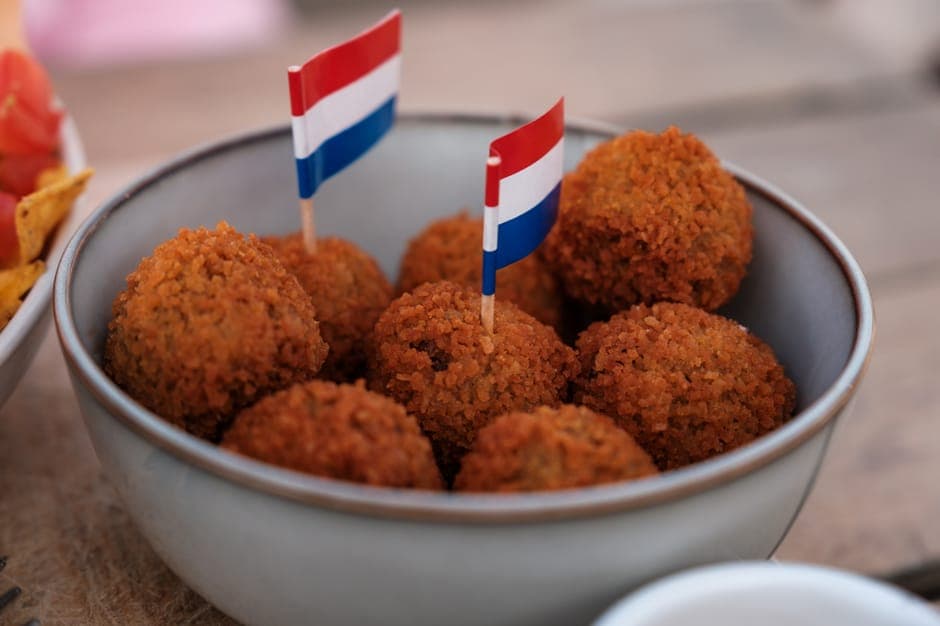
Bitterballen (Dutch Beef Ragout Croquettes)
Netherlands' most popular bar snack — crispy, golden deep-fried balls with a molten beef ragout centre. Served with Dutch mustard at every café and birthday party. The essential Dutch bite.
About This Recipe
Bitterballen are the defining snack food of Dutch café culture and are consumed in enormous quantities — at birthday parties (verjaardagen), at the legendary Dutch institution of 'borreltijd' (drinks time), and at every bruine kroeg (brown pub) in Amsterdam. They are essentially small, spherical Dutch beef croquettes: a thick, deeply savoury beef ragout (made from slow-braised beef in a rich roux sauce) is cooled until solid, shaped into small balls, breaded and deep-fried until shattering crispy on the outside with a molten, steaming ragout centre. The challenge and the joy: biting in carefully to avoid a scalding interior while dipping in sharp Dutch mustard.
Ingredients
Serves 6
- 300 gbeef brisket or chuck(braised until tender, shredded)
- 60 gbutter
- 60 gplain flour
- 400 mlbeef stock(warm)
- 1 tbspWorcestershire sauce
- 1 tbspDijon mustard
- 2 tbspfresh parsley(finely chopped)
- 0.5 tspnutmeg
- 1 tspsalt
- 0.5 tspwhite pepper
- 3eggs(beaten, for coating)
- 150 gfine dry breadcrumbs
- plain flourfor dusting
- 1 litrevegetable oil(for frying)
- Dutch mustard (Zaanse mosterd)to serve
Instructions
- 1
Make ragout
Melt butter in a saucepan. Whisk in flour and cook 2 min (roux). Gradually add warm stock, whisking constantly until smooth and thick. Add shredded beef, Worcestershire, mustard, parsley, nutmeg, salt and pepper. Cook stirring 5 min.
- 2
Set the ragout
Pour into a shallow dish. Cover with plastic wrap directly on the surface. Refrigerate minimum 3 hours or overnight until completely solid — it must be firm enough to shape.
The ragout must be very firm when cold. If it is too soft to shape, add 1 tbsp more flour to the mix and re-cook briefly.
- 3
Shape
With cold, wet hands, roll tablespoons of the firm ragout into small balls (3–4cm diameter). Work quickly — warmth will soften them. Return shaped balls to the fridge 30 min.
- 4
Bread
Roll each ball in flour, then beaten egg, then breadcrumbs. Double-coat: dip again in egg then breadcrumbs for an extra-crispy shell. Return to fridge 30 min.
- 5
Deep fry
Heat oil to 180°C. Fry bitterballen in batches of 6, 2–3 min until deep golden. Drain on paper towels.
- 6
Serve
Serve immediately with Dutch mustard for dipping. The interior should be molten — warn guests to bite carefully.
Did you make this?
Rate it and help other cooks find the recipes that actually work.
One tap to sign in, and we'll save the rating you just picked.
Everything you need to plan your week — free
- Meal calendar
- Grocery list
- AI recipe ideas
Cook this hands-free
Get AI meal plans, step-by-step cooking mode, and your saved recipes in the free Bento app.
Pro Tips
- →
Double breading is important — the extra coating prevents the molten interior from bursting through during frying.
- →
The ragout must be fully cold and firm before shaping — warm ragout will not hold its shape.
- →
Taste and adjust salt at the very end — flavors concentrate as liquids reduce, and a final pinch of flaky salt sharpens the whole dish.
- →
Mise en place pays for itself: chop, measure and pre-mix everything before the heat goes on, especially for any step that moves fast.
Variations
- •
Cheese bitterballen: replace beef with a thick Gouda cheese sauce
- •
Mushroom ragout for a vegetarian version
- •
Add curry powder to the ragout for a Dutch-Indonesian fusion version (kroket kari)
- •
Vegetarian: swap the protein for roasted king oyster mushrooms, smoked tofu or cooked chickpeas — adjust seasoning slightly upward to compensate.
Storage
Shaped, breaded bitterballen freeze very well — fry directly from frozen, adding 1 extra minute.
History & Origin
Bitterballen evolved from the Dutch kroket (croquette) in the 18th–19th century. The smaller spherical format was designed specifically as a one-bite snack to accompany 'bitters' (Dutch genever gin). The tradition of serving bitterballen at borrels (drinks gatherings) is so deeply embedded in Dutch culture that the bitterbal is often cited as the most representative Dutch snack internationally.
Frequently Asked Questions
What is Dutch mustard (Zaanse mosterd)?
Zaanse mosterd is a coarse-ground Dutch mustard from the Zaandam region with a sharp, grainy texture and strong flavour. It is sharper and more pungent than Dijon but less so than English mustard. It is available in Dutch specialty food shops and some supermarkets. Any coarse-grain mustard makes a good substitute.
Can I make this ahead of time?
Yes — most of the components can be prepared up to a day in advance and refrigerated separately. Reheat gently and assemble just before serving so textures stay distinct.
What can I substitute if I don't have all the ingredients?
Stay close to the role each ingredient plays: swap aromatics for similar ones (shallot for onion, lime for lemon), and keep the fat-acid-salt balance intact. Spice blends can usually be approximated with what's in the cupboard.
How do I know it's authentic?
Authenticity sits on a spectrum — what matters more is honoring the technique and balance of flavors. If the dish tastes harmonious and respects how cooks in its home region would build it, you're on solid ground.
Nutrition Facts
Per serving · 6 servings total
Time Summary
Have Questions?
Ask our AI cooking assistant anything about this recipe — substitutions, techniques, scaling.
Chat with AI Chef →Featured in Guides
This recipe is featured in the following curated guides:
More Dutch Recipes
You Might Also Like
Similar dishes from other cuisines around the world.
Browse by Ingredient
More recipes built around the same core ingredients.
Free Kitchen Tools
Calculators and converters that pair with this page — no signup needed.
Put This Into a Plan
Schedule it, shop for it, and track what you already have.
Read Next
Longer reads that go deeper on the ideas behind this dish.
Community
Join the conversation
Sign in to leave a comment and save your favourite recipes