
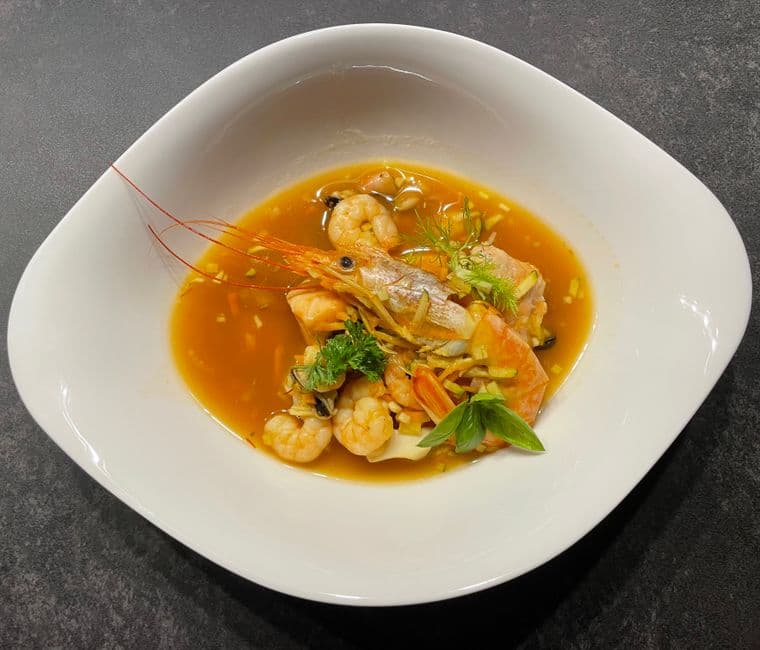
Manx Fish Stew
Hearty traditional stew featuring local fish, potatoes, and vegetables from the Isle of Man.
About This Recipe
Manx fish stew is the kind of dish that fishermen's families have been feeding themselves from for generations — a simple, hearty one-pot built around whatever the Irish Sea delivered that morning. The Isle of Man's waters support populations of cod, haddock, plaice, pollock, and whiting, and the great virtue of this stew is that it accommodates all of them, individually or in combination, adjusting naturally to whatever is freshest at the quayside. The broth base is modest but effective: onion softened slowly in butter, Manx potatoes (the island grows a distinctive heritage variety called Manx Earlies known for their waxy texture and delicate flavor) cooked in good fish stock until they are almost — but not quite — tender before the fish is added. The cream is added last and barely heats through; it rounds the brininess of the stock and creates a rich, ivory-colored liquid that clings to the fish rather than pooling separately. The sequence of addition is the most important technical point in this recipe: the potatoes need 20 minutes of simmering before the fish enters the pot because white fish cooks in 6-8 minutes at a brisk simmer and a single minute of overcooking causes the flesh to tighten into chalky, dry flakes that fall apart unpleasantly. Adding fish to under-cooked potatoes and then cooking until both are done is the most common error in fish stew, and the result is mealy fish surrounded by barely-cooked starch. Get the potatoes tender first, add the fish, and set a timer. The result — when the fish is just barely opaque all the way through and the cream has knitted into the stock — is a deeply warming, generously flavored stew that speaks directly to the island's relationship with the sea.
Ingredients
Serves 4
- 500 gmixed white fish fillets(cod, haddock, or pollock — skin removed, cut into 5cm chunks)
- 400 gwaxy potatoes(Manx Earlies or Charlotte variety, peeled and cut into 2cm dice)
- 1 largeonion(halved and thinly sliced)
- 2 stalkscelery(finely sliced)
- 2 clovesgarlic(minced)
- 30 gunsalted butter
- 500 mlfish stock(good quality, not salty)
- 100 mldouble cream
- 2 tbspfresh flat-leaf parsley(chopped, to finish)
- to tastefine sea salt and white pepper
Instructions
- 1
Soften the aromatics
Melt the butter in a large, heavy-bottomed saucepan or casserole over medium-low heat. Add the sliced onion and celery and cook, stirring occasionally, for 8-10 minutes until completely soft and translucent — the onion should lose all its raw sharpness and become sweet and yielding. Add the garlic and cook for a further 1 minute, stirring, until fragrant.
Do not rush this stage by increasing the heat — undercooked onion gives the finished stew a raw, sharp edge that no amount of cream will fix. Low and slow is the correct approach.
- 2
Add potatoes and stock
Add the diced potatoes to the softened aromatics and stir to coat them in the buttery base. Pour in the fish stock and bring to a brisk simmer over medium-high heat, then reduce to a steady gentle simmer. Cook uncovered for 18-20 minutes, stirring occasionally, until the potatoes are completely tender when pierced with a knife — no resistance should remain at the center.
- 3
Check the liquid level
Before adding the fish, check that the liquid still covers the potatoes by at least 2cm; if it has reduced significantly, add 100-150ml of boiling water or additional stock. The stew should have enough broth to cook the fish evenly — if the fish sits above the liquid line, the top will steam unevenly while the submerged portion overcooks.
- 4
Add the fish
Nestle the fish chunks gently into the simmering stew, pushing them just below the surface. Maintain a gentle simmer — not a rolling boil, which would break apart the delicate fish — and cook for 6-8 minutes. The fish is ready when it has turned completely opaque all the way through and flakes easily when pressed with a fork, but still holds its shape in recognizable pieces.
Set a timer the moment the fish goes in. Even 2 minutes of over-simmering causes the flesh to tighten and become dry. Check at 6 minutes and err on the side of slightly underdone — carryover heat will finish it as you add the cream.
- 5
Finish with cream
Reduce the heat to the lowest setting. Pour in the double cream and stir it gently through the stew, taking care not to break up the fish pieces. Heat for 2-3 minutes until the cream is fully incorporated and the stew is steaming hot throughout — do not allow it to boil once the cream has been added, as rapid boiling can cause the cream to split and produce a greasy, curdled appearance.
- 6
Season and serve
Taste the broth and season with fine sea salt and white pepper — start conservatively, as fish stock can be saltier than expected. Ladle into warmed deep bowls, scatter generously with chopped fresh parsley, and serve immediately with crusty sourdough or brown bread and Irish butter on the side.
Did you make this?
Rate it and help other cooks find the recipes that actually work.
One tap to sign in, and we'll save the rating you just picked.
Everything you need to plan your week — free
- Meal calendar
- Grocery list
- AI recipe ideas
Cook this hands-free
Get AI meal plans, step-by-step cooking mode, and your saved recipes in the free Bento app.
Pro Tips
- →
Source the freshest possible fish — ask your fishmonger what came in that morning. Fish stew is a vehicle for showcasing excellent ingredients, and the quality of the fish is far more important than the exact variety used.
- →
Waxy potato varieties hold their shape far better than floury ones during the long simmer; a floury potato (like Maris Piper) will begin to crumble into the broth and make the stew cloudy and starchy. Charlottes, Jersey Royals, or Manx Earlies are all excellent choices.
- →
Homemade fish stock is straightforward: simmer prawn shells, a halved onion, a celery stalk, bay leaf, and a few parsley stalks in cold water for 20 minutes, then strain. The difference versus shop-bought stock is immediately apparent in the depth of flavor.
- →
A small pinch of saffron added to the stock with the potatoes gives the stew a beautiful golden color and a subtle floral complexity without overwhelming the fish — not traditional but very compatible with the flavor profile.
- →
Do not add shellfish (mussels, cockles) at the same time as white fish — they open and become tough in 3-4 minutes and should be added after the white fish has had its 5 minutes, in the final few minutes before the cream.
Variations
- •
Mussel and haddock version: add 400g of scrubbed live mussels in the final 4 minutes of cooking — they will open in the hot broth and add a deeply briny flavor. Discard any that remain closed after 4 minutes.
- •
Saffron and fennel variation: add a small fennel bulb, thinly sliced, with the onion at the start, and add a pinch of saffron threads to the stock before adding the potatoes. Finish with a tablespoon of pastis (Pernod) in place of some of the cream for a Provençal-inspired character.
- •
Lighter dairy-free version: replace the double cream with 150ml of coconut cream and add a teaspoon of fresh ginger and a squeeze of lime juice — an unexpected but well-balanced twist that pairs well with the sweetness of fresh fish.
- •
Smoked fish version: replace half the fresh white fish with hot-smoked haddock or smoked cod fillets. The smoky richness transforms the stew's character entirely, producing something closer to a Scottish cullen skink.
Storage
Manx fish stew keeps in the refrigerator for up to 2 days in a sealed container, though the fish continues to soften during storage. Reheat very gently over low heat, stirring occasionally, until just steaming — do not boil, as this will cause the cream to split and the fish to become rubbery. The stew does not freeze well because the cream breaks down during freezing and the fish becomes mealy on thawing.
History & Origin
Fish stew traditions around the Isle of Man developed naturally from the island's centuries-long dependence on the Irish Sea fisheries, which provided herring, cod, and whiting as primary protein sources for island communities from medieval times onward. The addition of cream reflects the island's dairy farming heritage — Manx Loaghtan sheep and dairy cattle have been kept on the island since at least the Norse settlement period — and the combination of fish stock with cream appears in 18th-century Manx household records as a standard technique for stretching expensive fish into a more filling meal.
Frequently Asked Questions
What type of fish works best in this stew?
Any firm white fish with moderate fat content works well — cod, haddock, pollock, and hake are all excellent choices. Avoid very delicate fish like sole or plaice, which break apart too easily; also avoid oily fish like mackerel or salmon, whose strong flavor overpowers the cream broth. A mixture of two or three different white fish varieties gives the most interesting and complex flavor.
Can I make this stew without cream?
Yes — the stew is fully functional without cream, producing a cleaner, lighter broth that lets the fish flavor stand more prominently. Replace the cream with an additional 100ml of stock and a tablespoon of butter stirred in at the end for richness. A dairy-free version using full-fat coconut milk in place of the cream also works surprisingly well and gives the stew a subtle sweetness.
My fish is breaking apart and falling to pieces. What went wrong?
This happens when the stew is simmering too vigorously or the fish has been cooked for too long. White fish fillets are structurally fragile and need gentle heat — a slow simmer with just occasional small bubbles, never a rolling boil. Add the fish in the final 6-8 minutes only, after the potatoes are fully cooked, and check it every minute from the 6-minute mark. Once it is opaque throughout, remove from heat immediately.
Can I make the stew base ahead and add the fish later?
Yes — this is actually the recommended approach for dinner parties. Make the broth with the potatoes up to a day in advance and refrigerate. When ready to serve, bring the base back to a simmer, add the fish, and finish with cream as described. This way the fish is perfectly cooked and you avoid the stress of timing everything simultaneously.
How do I make fish stock if I do not have any?
The quickest option is to use a good-quality fish stock cube or pot (Knorr and Essential Cuisine both make acceptable versions) dissolved in hot water, but reduce the amount you add by 20% and add water to make up the difference, as bought stock cubes tend to be very salty. Alternatively, ask your fishmonger for fish frames (carcasses) or prawn shells and simmer them in cold water with an onion, celery, bay leaf, and parsley stalks for 20 minutes — this produces a genuinely superior base.
Nutrition Facts
Per serving · 4 servings total
Time Summary
Have Questions?
Ask our AI cooking assistant anything about this recipe — substitutions, techniques, scaling.
Chat with AI Chef →Featured in Guides
This recipe is featured in the following curated guides:
More Isle-of-man Recipes
You Might Also Like
Similar dishes from other cuisines around the world.
Free Kitchen Tools
Calculators and converters that pair with this page — no signup needed.
Put This Into a Plan
Schedule it, shop for it, and track what you already have.
Read Next
Longer reads that go deeper on the ideas behind this dish.
Community
Join the conversation
Sign in to leave a comment and save your favourite recipes