
In This Article
Track what you eat
Snap your meal to log calories and macros, run fasting timers and track water in the free SnapCal app.
Related Recipes
Related Guides
Medical disclaimer: The information in this article is for educational purposes only. Always consult a qualified healthcare professional before making significant dietary or lifestyle changes, especially if you have a medical condition.
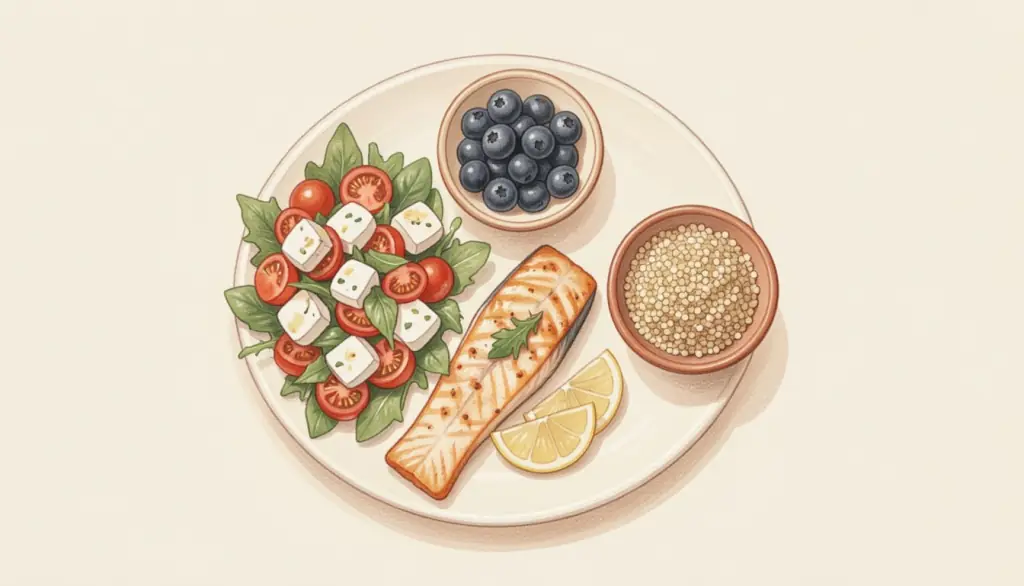
The Mediterranean, DASH and MIND diets are among the most studied eating patterns in the world, and they are often recommended in the same breath. Look closely and they are not three different philosophies. They share a core of vegetables, fruit, whole grains, legumes, nuts and fish, and a limit on processed food, red meat and sweets. What differs is the problem each was built to solve, and a handful of specific food rules. That makes choosing between them less about which is best and more about which framing fits your goal and your life. This hub guide compares them side by side, explains where they overlap, and ends with a simple decision guide.
Key Takeaways
Three diets, one shared backbone.
• The Mediterranean diet is a traditional-style pattern with olive oil, vegetables, legumes, whole grains and fish; it has the strongest evidence for heart health. • The DASH diet was designed specifically to lower blood pressure and sets out food-group servings and sodium limits. • The MIND diet blends the two, with extra emphasis on leafy greens and berries, and was built around brain health. • For most people the differences are small; any of the three beats a typical highly processed diet. • If you have a medical condition such as high blood pressure, work with your doctor or a registered dietitian rather than self-prescribing.
What each diet was designed for
Mediterranean is not a single formal diet but a pattern drawn from the traditional eating of countries around the Mediterranean Sea. It was studied widely for heart health, and the large PREDIMED trial in Spain found fewer cardiovascular events in groups assigned a Mediterranean diet with extra olive oil or nuts compared with a control diet. See our Mediterranean diet beginners guide for a full introduction.
DASH (Dietary Approaches to Stop Hypertension) was developed in U.S. trials funded by the National Institutes of Health to test whether food patterns could lower blood pressure. Trials showed that the DASH eating pattern reduced blood pressure, and that lowering sodium helped further. Our DASH diet blood pressure guide covers it in detail.
MIND (Mediterranean-DASH Intervention for Neurodegenerative Delay) was created by researchers at Rush University to combine the two with foods linked to brain health. Read more in our MIND diet guide.
Where the three overlap
The overlap is large, and it is the most useful thing to understand. All three emphasize vegetables and fruit, whole grains, legumes, nuts and seeds, and unsaturated fats such as olive oil. All three favor fish and poultry over red meat, and all limit sweets, processed foods and, to varying degrees, saturated fat.
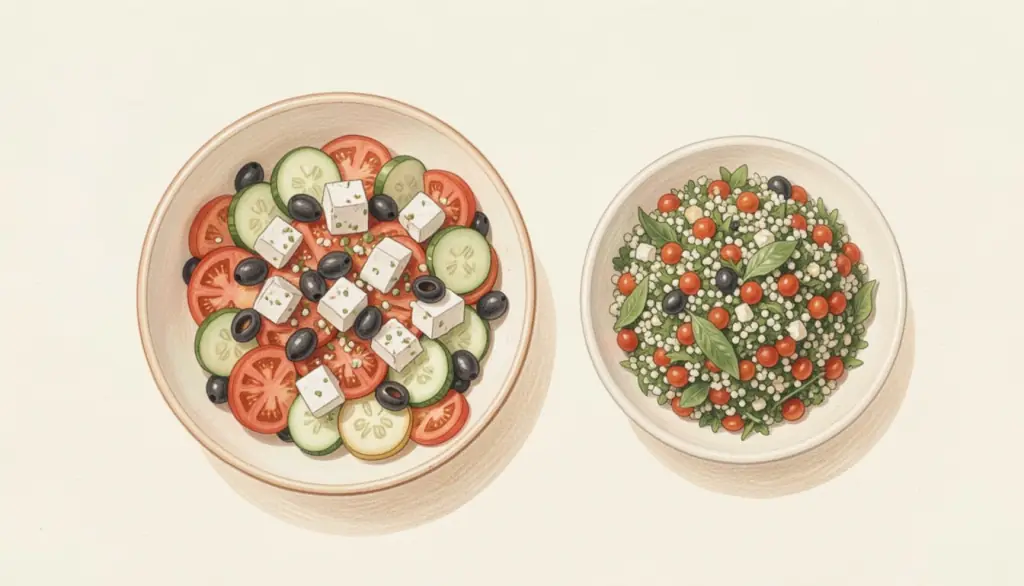
That shared core is the real message. If you move from a diet heavy in refined carbs, processed meats and fast food toward any of these patterns, you capture most of the benefit. The finer differences matter mainly at the margins. A meal like Greek salad fits all three, and a quinoa Mediterranean bowl is a good example of a plate that satisfies the overlap.
Where they differ: the food rules
Mediterranean has no fixed servings. It encourages olive oil as the main fat, plenty of plant foods and fish, moderate dairy and poultry, and little red meat. Wine in moderation appears in traditional versions, but it is optional and not recommended for everyone.
DASH is the most prescriptive on quantities. It sets daily and weekly servings by food group and puts sodium front and center: the standard version aims for no more than 2,300 mg a day, and a lower version for 1,500 mg. It emphasizes low-fat dairy, which Mediterranean and MIND treat more loosely.
MIND singles out ten brain-healthy groups, notably leafy green vegetables (at least six servings a week), berries (at least twice a week), nuts, beans, whole grains, fish and poultry, and olive oil, and sets limits on red meat, butter and margarine, cheese, pastries and sweets, and fried or fast food. It does not stress fruit overall the way the others do; berries are the focus.
If rules feel overwhelming, ignore the differences and aim for the shared core: more vegetables, legumes, whole grains, fish and nuts; less processed food and sugar.
Everything you need to plan your week — free
- Meal calendar
- Grocery list
- AI recipe ideas
What the evidence shows for each
The Mediterranean pattern has the deepest evidence for heart health and has been studied in randomized trials and large observational studies. DASH has strong trial evidence for lowering blood pressure, with the biggest effects typically seen in people who start with higher readings. The sodium-lowering arms add to the effect.
MIND is the newest. Early observational research linked closer adherence to a lower risk of Alzheimer's disease, but a more recent randomized trial in older adults found no significant difference in cognitive decline between the MIND group and a control group, though both groups improved. That does not mean the diet is harmful; it means the brain-specific advantage over general healthy eating is not proven. Our article on the Mediterranean diet and brain health has more.
Decision guide: which one to choose
For blood pressure: DASH is the most targeted choice, with sodium guidance built in. Check with your doctor, particularly if you take blood pressure medication.
For general heart health: Mediterranean has the strongest overall evidence and is the most flexible. See our heart health diet guide.
For brain health: MIND gives a clear checklist, but the evidence for a brain-specific benefit is still developing; a Mediterranean-style pattern with extra greens and berries is a sensible approach.
For simplicity: Mediterranean, because it has fewer numeric rules. For structure: DASH or MIND, which give you targets.
You do not need to choose forever. Many people start with one and drift toward the shared center. To put any of them into practice, build a week of meals with a meal planner so the shopping and cooking are sorted in advance.
Pick the one whose rules you will actually follow for a year, not the one that sounds strongest for a month.
Shopping list for the shared core
Because the three patterns overlap so much, one shopping list covers most of what you need. Fill the trolley with leafy greens, other vegetables of every color, berries and other fruit, whole grains such as oats, brown rice, quinoa and whole-wheat bread, and legumes such as lentils, chickpeas and beans. Add nuts and seeds, extra-virgin olive oil, fish (including oily fish such as salmon or sardines), skinless poultry, eggs and plain yogurt.
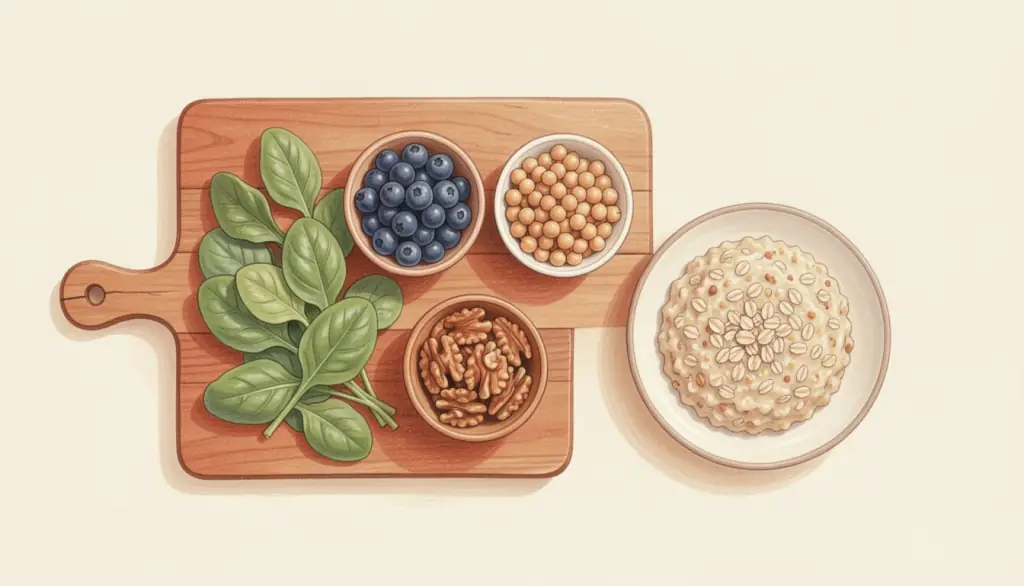
Tilt the list depending on your goal. For DASH, favor low-fat dairy and check sodium on canned and packaged foods. For MIND, make sure greens and berries are on every list. For Mediterranean, prioritize olive oil and fish. Turning the list into a plan is easier with a grocery list tool that collects the ingredients from your planned meals.
The usual mistakes are about execution rather than theory. People treat olive oil as unlimited, forgetting it is calorie-dense. They keep eating refined carbs and call it Mediterranean because there is pasta on the plate. They count salty processed foods such as canned soups, cured meats and cheese as healthy and overshoot sodium on a DASH plan. Or they go all in, burn out in two weeks, and return to old habits.
Change a few things at a time instead. Swap your cooking fat first, then add a daily vegetable-heavy meal, then shift your protein toward fish, beans and poultry. Over a few months the pattern becomes habit. If you want a pace to follow, build one new dinner per week from the shared core and repeat the ones you like.
A sample day that works for all three
Breakfast: oatmeal with berries and walnuts, or Greek yogurt with fruit.
Lunch: a big salad with leafy greens, chickpeas, olives, cucumber and olive oil, with whole-grain bread. A tabbouleh side adds herbs and whole grains.
Dinner: baked or grilled fish with roasted vegetables and a whole grain such as quinoa or brown rice.
Snacks: a handful of nuts, fruit, or raw vegetables with hummus.
This day respects the Mediterranean emphasis on olive oil and fish, the DASH emphasis on vegetables, fruit and whole grains, and the MIND emphasis on greens, berries and nuts. If you are watching sodium, go easy on olives, canned beans and cheese, or rinse canned beans.
Who should talk to a doctor first
All three patterns are generally considered safe for healthy adults, but individual circumstances matter. Speak to your doctor or a registered dietitian before making major changes if you have high blood pressure and take medication, kidney disease (DASH is rich in potassium and phosphorus, which can be a concern), diabetes, take blood thinners such as warfarin (changes in leafy green intake affect vitamin K), or have food allergies.
These patterns are not treatments for any disease and should not replace medical care. Alcohol, which appears in traditional Mediterranean eating, is not advised for pregnancy, certain medical conditions or when taking some medications. If you have had an eating disorder, avoid adopting strict rules without professional support.
Key Takeaways
The honest answer to Mediterranean versus DASH versus MIND is that they are variations on one theme. Choose DASH if blood pressure is your priority, Mediterranean for heart health and simplicity, and MIND if you want a brain-focused checklist, while remembering that the brain-specific evidence is still developing. Whichever you pick, the shared core of vegetables, legumes, whole grains, fish, nuts and olive oil does most of the work. Start there, adapt it to your tastes, and involve your doctor if you have a medical condition.
Frequently Asked Questions
Which is healthier, the Mediterranean or DASH diet?▼
Is the MIND diet just the Mediterranean and DASH diets combined?▼
Can I follow all three at once?▼
Which diet is best for weight loss?▼
Do I need to drink wine on a Mediterranean diet?▼
References
- [1]Estruch R, Ros E, Salas-Salvado J, et al. (2018). “Primary Prevention of Cardiovascular Disease with a Mediterranean Diet Supplemented with Extra-Virgin Olive Oil or Nuts.” New England Journal of Medicine.
- [2]Sacks FM, Svetkey LP, Vollmer WM, et al. (2001). “Effects on Blood Pressure of Reduced Dietary Sodium and the Dietary Approaches to Stop Hypertension (DASH) Diet.” New England Journal of Medicine.
- [3]Morris MC, Tangney CC, Wang Y, et al. (2015). “MIND diet associated with reduced incidence of Alzheimer's disease.” Alzheimer's & Dementia.
- [4]Barnes LL, Dhana K, Liu X, et al. (2023). “Trial of the MIND Diet for Prevention of Cognitive Decline in Older Persons.” New England Journal of Medicine.
More in Diet Guides
View all

Free Kitchen Tools
Calculators and converters that pair with this page — no signup needed.
About This Article
Written by Elena Vasquez, Health & Nutrition Writer. Published November 12, 2026. Updated November 12, 2026.
This article cites 4 peer-reviewed sources. See the full reference list below.
Editorial policy: Articles are drafted with the help of AI tools, link to the sources they rely on, and are updated when we find an error or newer evidence. Health articles are general information, not medical advice.
About the Author
Covers metabolic health, intermittent fasting and the gut microbiome, focused on summarising evidence in plain language.