
In This Article
Track what you eat
Snap your meal to log calories and macros, run fasting timers and track water in the free SnapCal app.
Related Recipes
Related Guides
Medical disclaimer: The information in this article is for educational purposes only. Always consult a qualified healthcare professional before making significant dietary or lifestyle changes, especially if you have a medical condition.
When people talk about the Okinawa diet, they usually mean the way ordinary Okinawans ate for much of the twentieth century, before imported convenience foods became common on the islands. It was not a diet in the modern sense, with rules and a start date. It was a food culture: sweet potatoes as the everyday staple, plenty of vegetables and soy foods, seaweed, small amounts of fish and pork, and a habit of stopping before you feel stuffed. Researchers have studied it because the islands have long been associated with unusually many people reaching very old age. The pattern is worth understanding for its own sake, whatever you make of the longevity headlines. This guide covers what the traditional diet contained, the principles behind it, how it differs from what most Okinawans eat today, and how to cook in that spirit at home without special ingredients.
Key Takeaways
The Okinawa diet is a mostly plant-based, low-processed pattern built around starchy vegetables rather than grains.
• The traditional staple was the sweet potato, not rice, with vegetables, soy foods and seaweed filling out most meals. • Fish, pork, eggs and dairy were eaten in small amounts, with pork reserved largely for celebrations. • Hara hachi bu, stopping at about 80 percent full, is the best-known eating habit. • The modern Okinawan diet looks much more like the rest of Japan and the West, and that shift is part of the story. • Longevity claims are associations, not guarantees, but the food pattern itself is balanced and easy to borrow.
Where the Okinawa diet comes from
Okinawa is a chain of islands in southern Japan, historically a separate kingdom with its own cuisine and trading links across East and Southeast Asia. Rice was hard to grow in much of the region and was often reserved for taxes and special occasions, so everyday eating leaned on sweet potatoes, which thrive in the local soil and survive typhoons better than many crops.
Research on the islands, including the long-running Okinawa Centenarian Study, described a traditional pattern that was relatively low in calories for its nutrient content, high in vegetables and soy, and low in refined foods. A frequently cited review, listed in the references below, summarizes that pattern in detail. For broader context on why researchers study places like this, see our overview of longevity diets in the Blue Zones, which this guide deliberately does not repeat.
Two cautions apply. First, this is observational research about a population and its lifestyle, including activity, community and gardening, not just food. Second, some researchers have questioned how well age records have been verified in certain longevity hotspots. Treat the Okinawa diet as a sensible eating pattern with a good track record in the literature, not as a proven way to live to 100.
The traditional foods, one by one
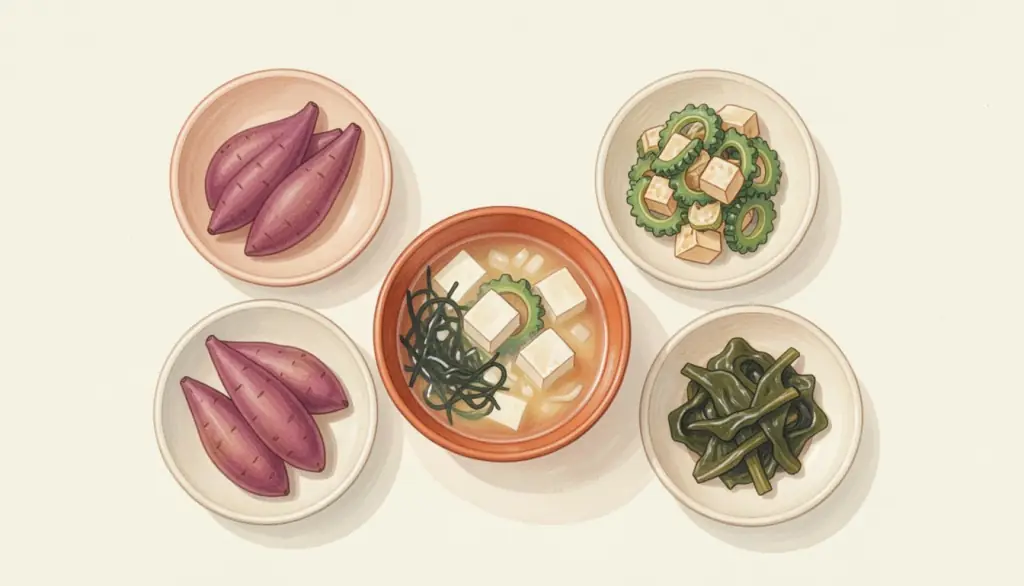
Sweet potatoes. The staple. The purple-fleshed varieties common in Okinawa are rich in pigments called anthocyanins and are starchy but fibrous and filling. They replaced the place rice or bread holds in many other diets.
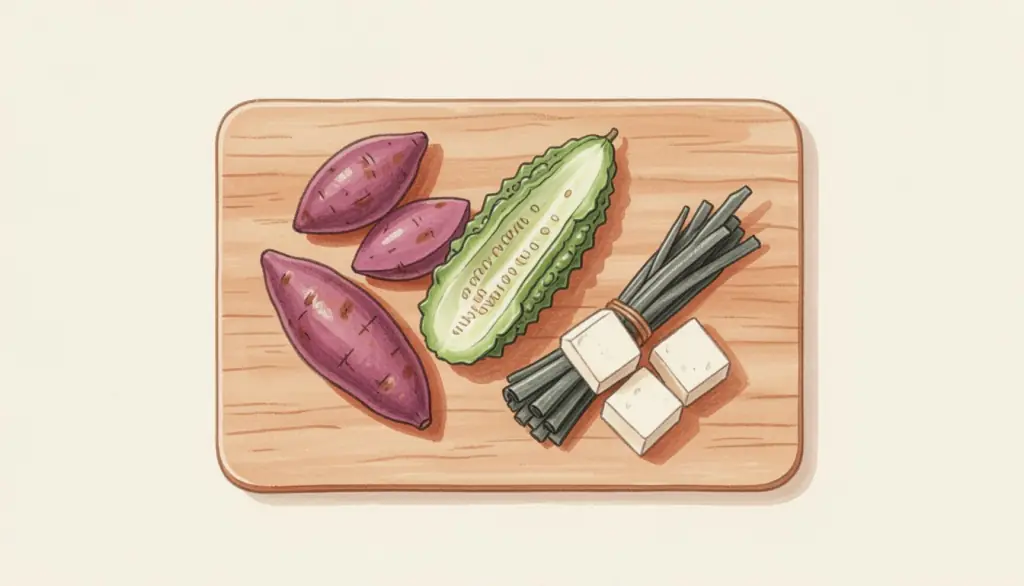
Vegetables. Leafy greens, daikon, pumpkin, cabbage, carrots, and above all goya, the bitter melon, appeared at nearly every meal, often stir-fried or simmered in soup.
Soy. Tofu, miso and other soy foods supplied much of the protein. Okinawan tofu is traditionally firmer and denser than the silken style many Western shoppers know.
Seaweed. Kelp (kombu) is used in cooking and stock far more in Okinawa than in many parts of Japan, and it is a natural source of iodine.
Fish, pork and eggs. Fish was eaten several times a week in many households. Pork was a celebration food, cooked in ways that stretched a small amount, and the fat was often skimmed or rendered off. Eggs and dairy were minor.
Flavorings. Turmeric, mugwort, ginger, garlic and jasmine tea are common, along with brown sugar and awamori, the local spirit, in modest amounts.
Hara hachi bu and other eating habits
Hara hachi bu is a saying often traced to a Confucian teaching: eat until you are eight parts full out of ten. In practice it means putting down your chopsticks while a little hunger remains, because the fullness signal arrives later than the last bite.
Other habits travel just as easily. Meals are built from several small dishes rather than one large plate, which slows eating and increases variety. Food is served in small bowls, so the visible portion is modest. Vegetables come first and rice or potato fills in the rest. And mealtimes are social, which tends to slow the pace.
The Japanese approach of one soup, one main and three sides is a close cousin; our guide to ichiju sansai meal planning shows how to structure it for a week.
Try the 80 percent rule at just one meal a day at first. Serve smaller portions in a small bowl, wait ten minutes, and only then decide on seconds.
Everything you need to plan your week — free
- Meal calendar
- Grocery list
- AI recipe ideas
How the modern Okinawan diet differs
The traditional pattern did not survive unchanged. After the Second World War, American influence and imported foods shifted eating habits across the islands. Meat, fried food, refined grains, sweetened drinks and fast food became common, and Spam, introduced during the postwar years, became a local staple that still appears in dishes like goya stir-fry. Younger generations eat much less like their grandparents.
One frequently reported consequence is that Okinawa's standing in national rankings for life expectancy has slipped, particularly among younger-to-middle-aged men, while the oldest generation, raised on the traditional diet, remains remarkable. That contrast is one reason the diet is studied: it looks like a natural experiment in what changes when a food culture is replaced. It is also a good reminder that a place is not a diet. Eating in Okinawa today does not automatically mean eating the traditional way.
A sample day, adapted for home
You do not need to find Okinawan sweet potatoes to follow the pattern. Here is a practical day using ingredients from a regular supermarket.
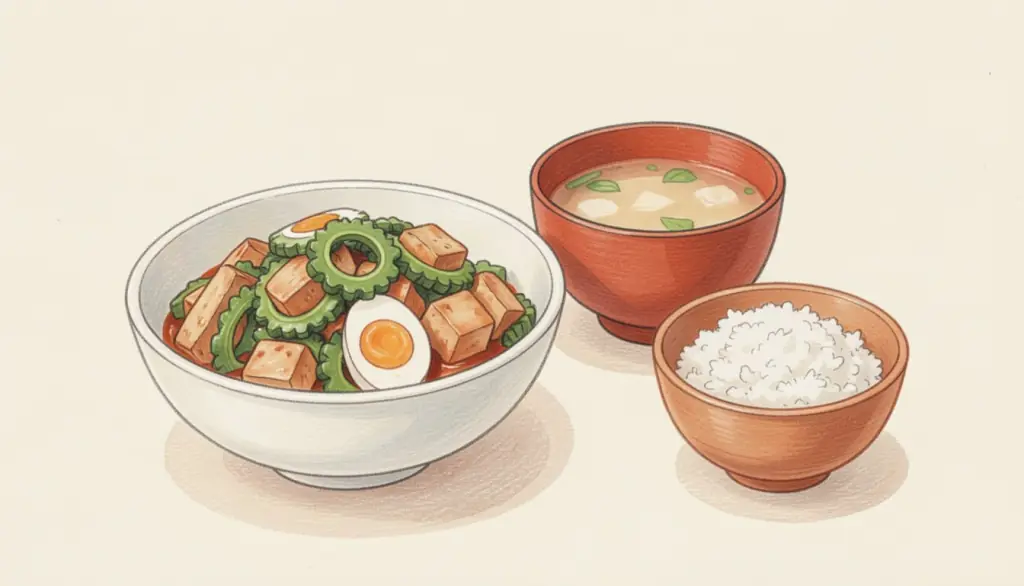
• Breakfast: miso soup with tofu and wakame, a small bowl of rice or a baked sweet potato, and a piece of fruit. • Lunch: a stir-fry of tofu with bitter melon or other greens, eggs if you like, and a bowl of mixed vegetables. Our recipe for Okinawan goya chanpuru is the classic version; it includes Spam, which you can swap for more tofu. • Dinner: grilled fish, a side of simmered kelp or greens, a vegetable soup, and sweet potato in place of rice. • Snack: roasted sweet potato, edamame, or a cup of jasmine tea.
Start with a bowl of authentic miso soup and you have already captured several principles in one dish: soy, seaweed, vegetables, and a warm, slow start to the meal. If you want the full picture of the fermented side of the cuisine, read our guide to miso, soy sauce and natto.
Pork the Okinawan way
Although the diet is mostly plants, pork is part of Okinawan culture, and understanding how it was used is useful. The famous dish rafute is pork belly simmered with awamori, brown sugar and soy sauce until tender, then chilled so the fat can be lifted off. It is a celebration dish, served in small pieces alongside vegetables or rice. If you want to try it, our Okinawan rafute recipe walks through the technique. The takeaway for everyday eating is proportion: meat in a small role, not the center of the plate.
Building the pantry and shopping list
A few items cover most of the pattern: sweet potatoes (any variety, ideally including purple ones), firm tofu, miso, dried kombu or wakame, shiitake mushrooms, frozen edamame, leafy greens, daikon, soy sauce, ginger and a small amount of fish. Our Japanese pantry essentials guide lists what to stock, and our piece on seaweed and iodine explains how to eat sea vegetables without overdoing the iodine, which matters if you have thyroid concerns.
If you plan your meals by the week, the meal planner calendar lets you lay out the week and see the nutrition totals, which helps when you are adjusting portions toward the 80 percent habit.
A simple weekly routine. You do not need to cook anything elaborate. Roast a tray of sweet potatoes on Sunday and use them through the week: in a bowl with greens and tofu, mashed into a soup, or as the starch beside fish. Keep a pot of dashi or kombu stock in the refrigerator so miso soup takes five minutes. Aim for fish two or three times a week, tofu or other soy foods on most days, and at least one leafy green or bitter vegetable daily. Save richer pork dishes for occasions, as Okinawans traditionally did.
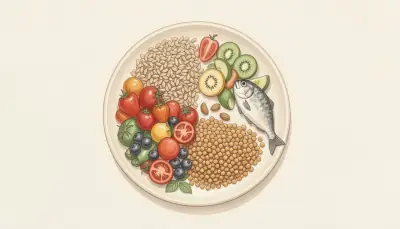
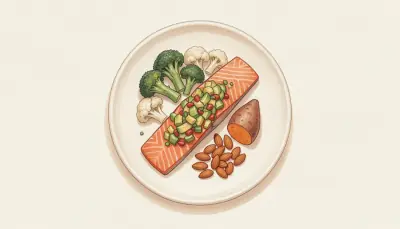
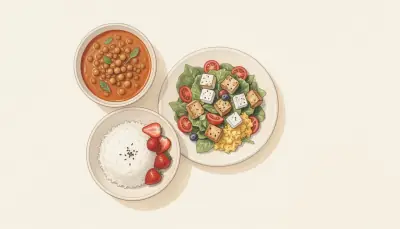
A good test of whether you are following the spirit of the diet is the plate itself: it should look colorful, include more than one small dish, and leave you comfortably satisfied rather than full.
Cook once, eat twice. A roasted sweet potato is an easy breakfast, a snack and a dinner side without extra effort.
Who should be careful
The Okinawa diet is generally balanced, but a few points deserve attention. It can be low in calcium and vitamin B12 if you eat very little fish or dairy. Seaweed contributes a lot of iodine, and people with thyroid conditions should discuss intake with their doctor. Miso and soy sauce are high in sodium, which matters for anyone managing blood pressure. Soy is safe for most people, but anyone with a soy allergy, a thyroid condition or on thyroid medication should ask a clinician about it. Older adults, pregnant people and anyone with a medical condition should not cut calories on the strength of hara hachi bu without professional advice. Eating until 80 percent full is a mindful habit, not a target for restriction, and it is not appropriate for anyone with a history of disordered eating.
If you take medication or have a chronic condition, talk to your doctor or a registered dietitian before making large changes to your diet.
Key Takeaways
The Okinawa diet is worth borrowing from not because it promises a long life but because it is simple, varied and plant-heavy, with small portions and little processing. Start with one habit this week: make a sweet potato your starch a few evenings, add a bowl of miso soup, or try stopping at 80 percent full. Keep meat and fish in smaller roles, watch the sodium in soy foods, and treat the longevity research as encouraging context rather than a promise. Eating this way is easy to sustain because it tastes good.
Frequently Asked Questions
What did people on Okinawa traditionally eat?▼
What does hara hachi bu mean?▼
Is the Okinawa diet vegetarian?▼
Do I need purple sweet potatoes to follow it?▼
References
- [1]Willcox DC, Willcox BJ, Todoriki H, Suzuki M (2009). “The Okinawan diet: health implications of a low-calorie, nutrient-dense, antioxidant-rich dietary pattern low in glycemic load.” Journal of the American College of Nutrition.
More in Diet Guides
View all
Free Kitchen Tools
Calculators and converters that pair with this page — no signup needed.
About This Article
Written by Sarah Mitchell, Food & Nutrition Writer. Published November 12, 2026. Updated November 12, 2026.
This article cites 1 peer-reviewed sources. See the full reference list below.
Editorial policy: Articles are drafted with the help of AI tools, link to the sources they rely on, and are updated when we find an error or newer evidence. Health articles are general information, not medical advice.
About the Author
Writes about everyday nutrition, balanced eating and turning dietary guidelines into practical, cook-at-home advice.