
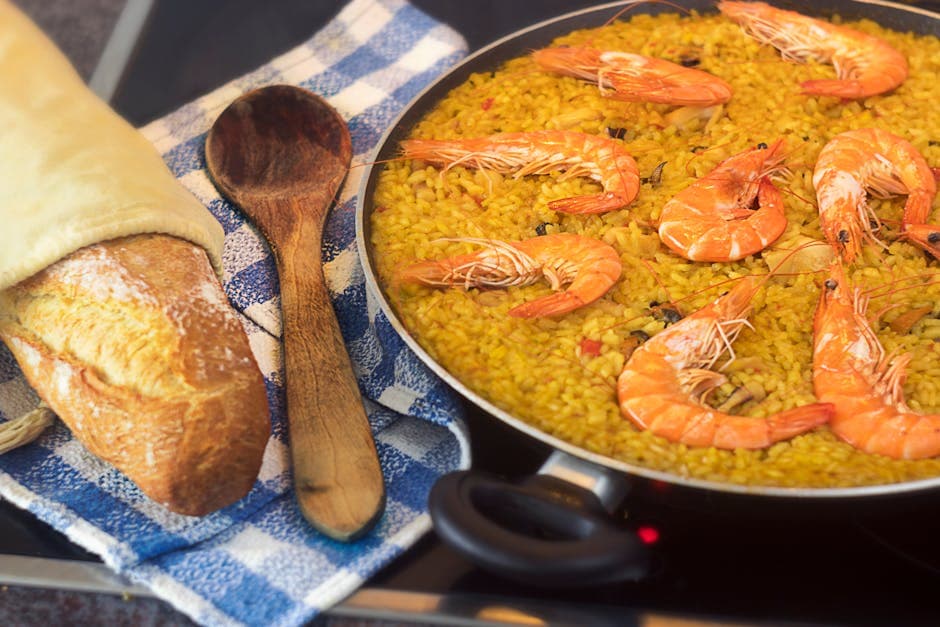
Fideuà (paella espagnole de nouilles aux fruits de mer)
La cousine paella aux nouilles de Valence — vermicelle courte et grillée cuite en style paella avec calmar, crevettes et bouillon safran, servie avec alioli à l'ail.
À propos de cette recette
La fideuà est la sœur de la paella, née sur la côte méditerranéenne de Valence dans les années 1930 lorsque (la légende raconte) le cuisinier d'un pêcheur du bateau « Santa Isabel » a remplacé les nouilles par du riz pour empêcher le capitaine gourmand de manger toute la poêle. Le plat est maintenant une icône valencienne et catalane, préparé dans la même grande poêle à paella plate, avec le même bouillon safran-tomate-fruits de mer, mais en utilisant de courtes nouilles tubulaires appelées fideos (semblables aux bucatini brisés) qui sont d'abord grillées dans l'huile d'olive jusqu'à ce qu'elles soient d'un brun noisette profond - ce grillage est ce qui donne au fideuà son arôme fumé, presque caractéristique, de café. Les nouilles sont ensuite entièrement cuites dans le bouillon de fruits de mer, en absorbant la saveur à mesure qu'elles se ramollissent, avec des calamars, des crevettes, des moules et du poisson blanc ajoutés au bon moment. Comme son cousin le riz, le fideuà récompense le cuisinier qui construit un bon socarrat - la couche inférieure croustillante prisée où les nouilles caramélisent contre la poêle - et est toujours servi avec un côté d'aïoli, l'émulsion piquante d'ail et d'huile d'olive que les convives mettent à chaque bouchée. La poêle va directement au centre de la table, et chacun mange avec une cuillère de son propre coin de la poêle. Un verre d'albariño ou de cava froid, un morceau de pain pour s'imprégner du bouillon et vous obtenez l'un des meilleurs repas que la côte méditerranéenne ait à offrir.
Ingrédients
Sert 4
- 300 gfideos (nouilles creuses courtes), ou morceaux de bucatini cassés de 1 cm
- 1.2 Lriche bouillon de poisson ou de fruits de mer (fait maison si possible), conservé au chaud
- 300 gcalamars frais, nettoyés et coupés en rondelles
- 12crevettes crues décortiquées
- 300 gmoules, débarrassées et lavées
- 200 gpoisson blanc ferme (lotte ou merlu), coupé en morceaux de 3 cm
- 1 grandetomate mûre, râpée (peau jetée)
- 1 petiteoignon, finement haché
- 4 goussesail, haché
- 1 c. à c.paprika fumé doux (pimentón dulce)
- 1 pincéefils de safran légèrement grillés et émiettés
- 5 c. à s.huile d'olive extra vierge
- 1 small bowlalioli (mayonnaise à l'ail), pour servir
- 1citron, coupé en quartiers
Étapes
- 1
Faire griller les nouilles
Faites chauffer 2 c. à soupe d'huile d'olive dans une large poêle à paella à feu moyen. Ajoutez les fideos et faites-les griller en remuant constamment avec une cuillère en bois, pendant 4–5 minutes, jusqu'à ce qu'ils prennent une couleur brun doré profond — presque celle du chocolat au lait. Cette étape est essentielle : des vermicelles non grillés donnent une fideuà sans saveur. Versez dans un bol et réservez.
- 2
Soften the aromatics
Ajoutez encore 2 c. à soupe d'huile dans la poêle. Saisissez les gambas 60 secondes par face jusqu'à ce qu'elles soient tout juste roses — elles finiront de cuire plus tard. Retirez-les dans une assiette. Ajoutez les calmars et saisissez-les 90 secondes jusqu'à ce qu'ils soient tout juste opaques ; retirez et réservez. La poêle doit maintenant être enduite d'huile teintée par les fruits de mer.
- 3
Add the stock
Ajoutez la 1 c. à soupe d'huile restante. Ajoutez l'oignon et faites cuire 5 minutes jusqu'à ce qu'il soit translucide et commence tout juste à colorer. Ajoutez l'ail et faites cuire 60 secondes. Ajoutez la tomate râpée et le paprika fumé, et faites cuire 6–8 minutes en remuant, jusqu'à ce que la tomate fonce et que l'huile commence à se séparer sur les bords — un véritable sofrito espagnol.
- 4
Scatter the squid
Incorporez le safran émietté et laissez-le infuser dans le sofrito 30 secondes. Ajoutez les morceaux de poisson blanc et remuez délicatement pour les enrober. Ils commenceront à se raffermir mais resteront crus à l'intérieur.
- 5
Final simmer and socarrat
Remettez les vermicelles grillés dans la poêle et remuez pour les mélanger au sofrito. Versez 1 L du bouillon chaud — il doit tout juste couvrir les vermicelles. Répartissez uniformément dans la poêle (ne remuez plus à partir de ce moment — la fideuà se prépare comme une paella, sans y toucher).
- 6
Discard unopened mussels
Portez à un fort frémissement. Faites cuire à feu moyen-vif pendant 8 minutes, puis disposez les calmars, les gambas et les moules sur le dessus, en les enfonçant légèrement dans les vermicelles. Faites cuire encore 6–8 minutes jusqu'à ce que le bouillon soit presque absorbé et que les vermicelles se tiennent debout. Ajoutez du bouillon chaud 100 ml à la fois seulement si nécessaire.
- 7
Serve at table
Augmentez le feu à vif pour les 90 dernières secondes — écoutez les vermicelles crépiter contre la poêle. C'est ce qui forme le socarrat, la précieuse couche croustillante du fond. Retirez du feu, couvrez sans serrer de papier aluminium et laissez reposer 5 minutes. Servez immédiatement directement dans la poêle avec des quartiers de citron et un généreux bol d'alioli à côté.
Vous l'avez cuisinée ?
Notez-la et aidez les autres à trouver les recettes qui fonctionnent vraiment.
Connectez-vous en un geste : nous enregistrons la note que vous venez de choisir.
Tout ce qu'il faut pour planifier votre semaine — gratuit
- Calendrier des repas
- Liste de courses
- Idées de recettes IA
Suivez ce que vous mangez
Photographiez votre repas pour enregistrer calories et macros, lancez des minuteurs de jeûne et suivez votre hydratation avec l’app gratuite SnapCal.
Conseils de pro
- →
Toasting the noodles is essential — this is what gives fideuà its signature smoky, nutty aroma. Don't skip this step; raw noodles produce a boring, flat dish.
- →
Use a wide, shallow paella pan (40 cm diameter is typical) — not a deep pot. The wide surface is what allows the socarrat to form.
- →
Ne remuez pas après avoir ajouté le bouillon. Comme la paella, la fideuà doit cuire sans y toucher pour développer ses couches et former un socarrat.
- →
L'alioli est indispensable à côté. Préparez-le au mortier et au pilon (3 gousses d'ail, ½ c. à café de sel, 1 jaune d'œuf, en versant lentement en filet 200 ml d'huile d'olive) pour obtenir l'émulsion authentique.
Variantes
- •
Fideuà noire (fideuà negra) — ajoutez 2 sachets d'encre de seiche avec le bouillon pour une spectaculaire couleur sombre.
- •
Terre et mer — ajoutez des morceaux de cuisse de poulet et de chorizo pour une version plus copieuse de l'intérieur des terres.
- •
Fideuà aux légumes — utilisez un riche bouillon de légumes et garnissez d'artichaut, de haricots blancs et de poivron rouge rôti.
- •
Fideuà au lapin — style de l'intérieur valencien, plus proche d'une paella de vermicelles avec des morceaux de lapin et du romarin.
Stockage
À déguster de préférence le jour même, à la poêle. Réfrigérez jusqu'à 2 jours ; réchauffez doucement dans une poêle couverte avec un trait d'eau (le micro-ondes rend les fruits de mer caoutchouteux et ramollit le socarrat). Ne se congèle pas bien — les vermicelles deviennent pâteux.
Histoire et origine
Fideuà is said to have been invented in the 1930s by a cook on a fishing boat called 'Santa Isabel' sailing off Valencia who substituted short noodles for rice when rice ran low. Whether true or apocryphal, the dish exploded in popularity throughout the 1960s and 70s and is now a signature Valencian and Catalan specialty, with as many regional variations as paella itself.
Foire aux questions
What's the difference between fideuà and paella?
Fideuà uses short toasted noodles instead of rice, is toasted and cooked in the pan (giving it a nuttier, more smoky flavor), and tends to be lighter and less heavy than rice paella. Both build a socarrat.
Can I use spaghetti or linguine?
No — you need short, thin, hollow noodles (fideos) or broken bucatini. Long pasta is wrong; it won't fit in the pan, won't toast properly, and ruins the texture.
What if I don't have saffron?
Non — la fideuà est un plat à faire dans l'heure. Préparez le bouillon et tous les ingrédients à l'avance, mais la cuisson doit se faire d'une seule traite, et le service doit être immédiat.
Is socarrat really burnt food?
Un albariño frais de Galice, un jeune Rueda blanc ou un cava pétillant conviennent tous parfaitement. Un rosé frais de Provence fonctionne aussi bien pour une fideuà d'été.
Faits nutritionnels
Par portion (420g) · 4 portions totales
Résumé du temps
Vous avez des questions ?
Demandez quoi que ce soit à notre assistant culinaire IA sur cette recette : substitutions, techniques, mise à l'échelle.
Discutez avec AI Chef →Plus de recettes espagnoles
Vous Aimerez Aussi
Des plats similaires venus d'autres cuisines du monde.
Parcourir par Ingrédient
D'autres recettes construites autour des mêmes ingrédients principaux.
Outils de Cuisine Gratuits
Calculateurs et convertisseurs qui accompagnent cette page — sans inscription.
Calculateur de proportions
Divisez par deux ou doublez chaque quantité de cette recette sans calcul mental.
Convertisseur de mesures
Convertissez tasses, grammes, onces et millilitres dans les deux sens.
Convertisseur pour friteuse à air
Convertissez le temps et la température du four en réglages pour friteuse à air.
Transformer en Plan
Programmez-le, faites les courses et suivez ce que vous avez déjà.
Calendrier de planification des repas
Placez cette recette sur un jour et organisez la semaine autour.
Appli de liste de courses
Transformez cette liste d’ingrédients en liste de courses regroupée par rayon.
Importateur de recettes
Enregistrez cette recette — et n’importe quelle URL de recette — dans une bibliothèque organisée.
À Lire Ensuite
Des articles de fond sur les idées derrière ce plat.
Communauté
Rejoignez la conversation
Connectez-vous pour laisser un commentaire et enregistrer vos recettes préférées